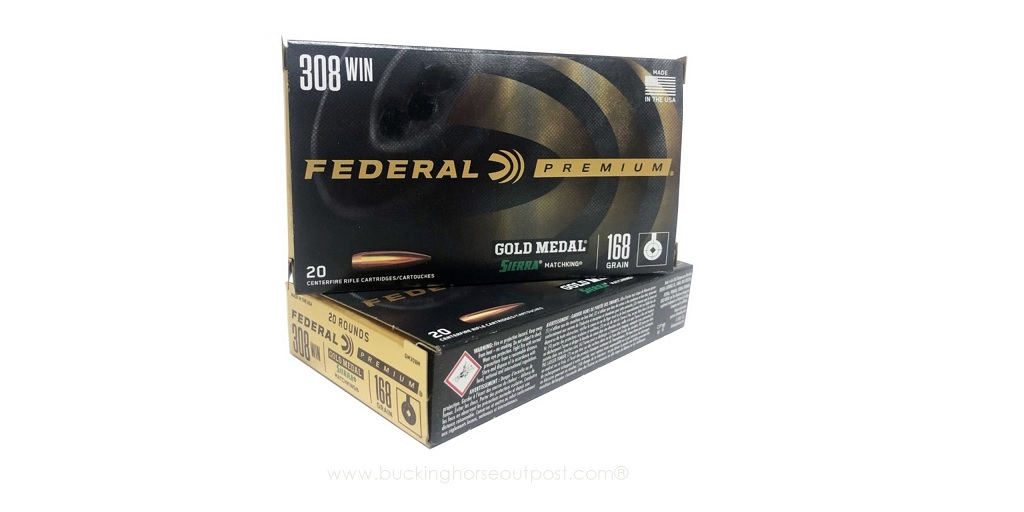
There is a class of ammo known as OTM, also known more properly as “open-tip match” ammo, and sometimes as hollow point (even though it isn’t really).
In the event that you are not familiar with it, and you are a long-range competitive shooter, it can change the way you think about your groupings at extended distances.
Here’s what you need to know about OTM match-grade ammo, like Federal Gold Medal Match ammo.
What Is OTM?
Open-tip match ammo, or OTM ammo, is the superior choice for long-distance competition (but not hunting, more on that in a bit).
This is because of how the ammo is produced. With a conventional FMJ round, the lead bullet core is swaged and then dropped into a copper jacket cup; then, the cup is drawn, from the nose down, to the base of the bullet.
This leaves the base of the bullet open but completely encases the core, otherwise, in a hard jacket that resists disruption on contact with a target.
With OTM ammo, like Federal Gold Medal Match, the process is reversed. The lead bullet core is swaged, and placed into a copper-alloy jacket cup.
But with OTM, the jacket is drawn up from the base, towards the nose, and formed very closely around the nose of the bullet, leaving only a small open hole (which is why it is sometimes referred to as hollow point, see below).
This process, which is the procedural antithesis to the production of FMJ ammo, results in bullets with a greater radial symmetry; this means that OTM ammo usually has a higher ballistic coefficient and therefore can be more effectively spin-stabilized by rifling, not to mention that it also resists wind deflection more effectively.
Is OTM the Same as Hollow Point?
OTM is sometimes labeled as hollow point, which sort of makes sense since technically the nose of the bullet is open. Categorically, and physically, it is a hollow point.
But ballistically, it is not. Hollow point ammo is designed to disrupt (expand) on impact with a target, specifically a soft one.
OTM ammo is designed only for accuracy. What happens on impact is not the concern of the ballisticians.
Therefore, OTM ammo, while excellent for competition, is not suitable for hunting.
Why Not Just Shoot FMJ?
You can, and FMJ is not a bad option for competition shooting, but it is also not match-grade.
It is affordable, and it penetrates targets well, but those are its two biggest selling points.
When it comes to superior accuracy thanks to higher ballistic coefficients, OTM ammo is a better choice all the way around.
Where Can You Get High-Quality Match-Grade Ammo Like Federal Gold Medal Match?
Looking for high-quality match-grade ammo like Federal Gold Medal Match, loaded with Sierra MatchKing bullets?
Visit Bucking Horse Outpost online. They carry a wide range of ammo including match-grade ammo, FMJ ammo, defensive ammo, and even frangible ammo. Take a look through their collection to learn more.