
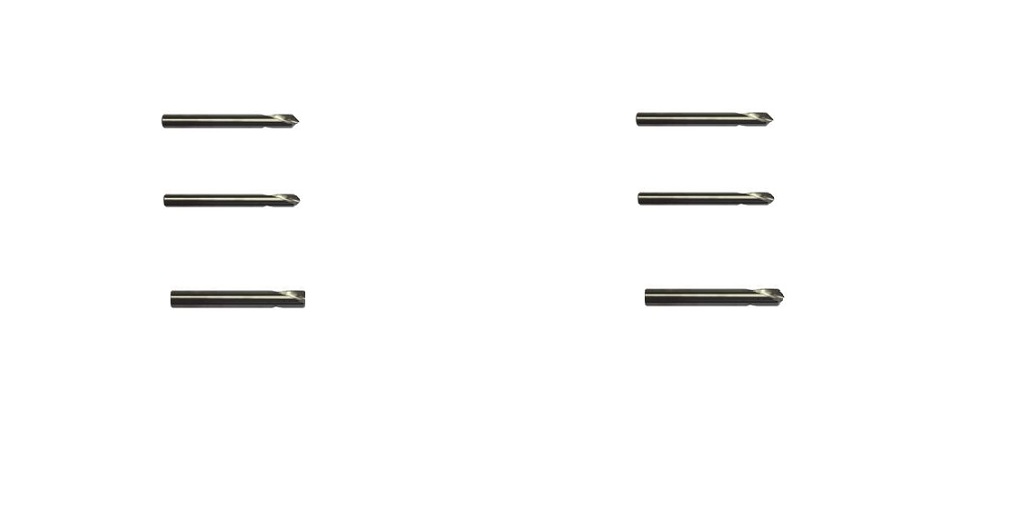
Spot drills and center drills are part of any drilling and machining operation. One of the most important aspects of machining parts is to drive holes with laser precision accuracy. You know that a hole that is off by a tenth of a millimeter can render a part useless, and there are no “undo” hotkeys in this business.
The problem is that twist drills or “jobbers” tend to “walk-off” when they first come in contact with a surface, especially when milling hard metal and alloys, no matter how tightly secured they are to the spindle. This happens because they are usually longer and more flexible than stub and spot drills.
Center Drills
Now, many CNC enthusiasts like using center drills for spotting since they are usually cheaper, and easier to find. However, the intended function of a center drill is to create a hole that helps secure a part in a lathe.
I can see why it might be the first pick for many when they understand the importance of spotting, as the pilot tip might suggest that it is its main purpose. However, if your operation requires a lot of spotting, the brittle center drill tip will not last too long.
There is one other problem: the countersink. When you’re spotting, you want a hole angle that is equal to or greater than the twist drill angle. If the opening is too narrow, the recently drilled dimple will be a death trap for your bits, especially if they´re carbide-coated.
Now, it does not mean that center drills are not good for spotting. They do a good job as long as you only use the tip of the pilot, and don’t abuse the tool. As we said before, the tip is very brittle and can only take you so far.
Spot Drills
True spot drills are the perfect tool for the job. They are chubby and rigid and generally provide the perfect anchorage for your jobber. The chunky shank helps to keep the tip right on target, providing maximum accuracy, and preventing it from walking off.
Some might say that spot drills are not necessary, or even detrimental if you´re using carbide drills. However, longer drill bits with carbide-coated tips are still too flexible and will deflect off or even start a hole at the wrong angle.
So, what’s the solution?
Just remember that the tip angle of your twist drill must at least match that of your spot drill. That is the best way to protect your sharp carbide edges to come in contact with tapered angles that can damage your carbide tips. A matching point angle will help your tool find purchase quickly and engage the material right off the bat.
There seem to be very few trustworthy spotting drill bit suppliers. If you want excellent customer service and really durable tools, visit www.onlinecarbide.com. They manufacture all of their carbide bits and have plenty of spot drills to choose from.
