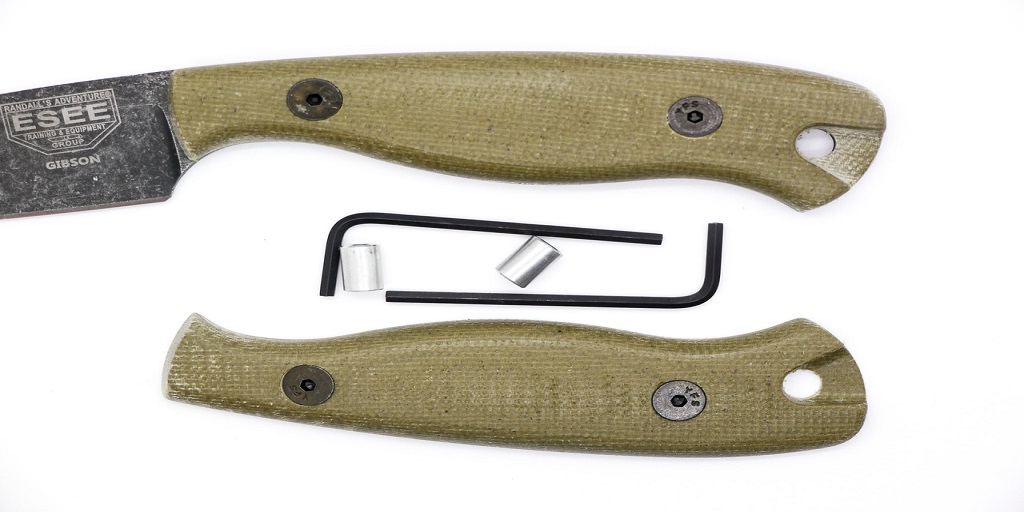
Knife handles (more commonly referred to as scales when they fit on either side of a full tang) are made from a variety of natural and synthetic materials. This short post will break down some of the differences between the more common materials.
Natural Materials
- Wood: Many knives sport either wood handles or scales. Commonly used woods include but are not limited to oak, beech, ebony, cherry, bocote and cocobolo, ironwood, maple and walnut, though many others could be used. Wood is comfortable, beautiful, and safe to grip with bare hands in the cold, but it should be kept clean, dry and protected against moisture, and also periodically cleaned and treated with conditioner or oiled.
- Stacked leather: Stacked leather grips, common on some Kabar and Ontario knives, are very comfortable, however, even if the leather is sealed (and it usually is) it must be protected against moisture.
- Horn or antler: Horn and antler are tough knife handle materials that are relatively impervious to most regular wear and use. They also require relatively low maintenance.
- Bone: Bone, such as jigged bone, is common on traditional pocket knife patterns. Like horn and antler, there are minimal maintenance considerations for bone-handled knives.
Synthetic Materials
- Phenolic: Phenolic is a type of hard, resin plastic that was once more common on knives. Some knives, such as the Buck 119 Special, are still made with it. It is light and tough and requires minimal maintenance.
- Polypropylene: Polypropylene is a lightweight plastic used as knife handles by some manufacturers, such as Morakniv. It is used mostly because it is cheap, but it is also fairly durable and is impervious to moisture and many chemicals.
- Kraton: Though knife handles are not typically made from Kraton, many are coated in it. It is a rubberized synthetic material (common on Cold Steel knives) that offers excellent traction, even in wet and cold conditions.
- Carbon fiber: Carbon fiber, also referred to as CF, is made of bundles of carbon fiber bound with epoxy. It is very light, very strong, relatively resistant to moisture and chemicals, and can be made in a variety of patterns and aesthetics.
- G10: G10 is a hard, tough synthetic material that is extremely durable. It is highly resistant to moisture, oil, grease, and many chemicals, and never needs any maintenance, making it one of the most popular synthetic knife scale materials.
- Micarta: Micarta is a textile such as canvas or linen impregnated with a resin under high heat and pressure. The result is a material that offers excellent traction and which requires effectively no maintenance.
- GFN: GFN or glass-filled nylon, is nylon that has been stabilized with fiberglass. It is both very strong and very lightweight, making it exceptionally popular as a knife scale material.
Metal Alloys
- Steel: Some knives have steel handles or scales. Steel is affordable and about as tough and strong as knife handle materials come, but it is also uncomfortable in the cold and doesn’t always offer the best traction. Also, steel can stain, corrode or rust if not properly cared for.
- Aluminum: Aluminum is lighter than steel and effectively as strong, plus it is chemically more stable. Also, aluminum can be anodized in a wide range of colors, making it popular as a knife scale material.
Here for a Knife Handle Upgrade?
Got a popular knife from ESEE or Becker, but want to upgrade the knife handle with new scales? Check out The Knife Connection. They make replacement knife scale upgrades compatible with multiple popular knife brands, in a wide variety of sizes, colors, and configurations.
Also, a knife handle upgrade is generally one of the easiest upgrades you can make to your knife. Check out their collection and get in touch with them if you have any questions.
For More Information About Pocket knives and White River Knives Please Visit: The Knife Connection.