
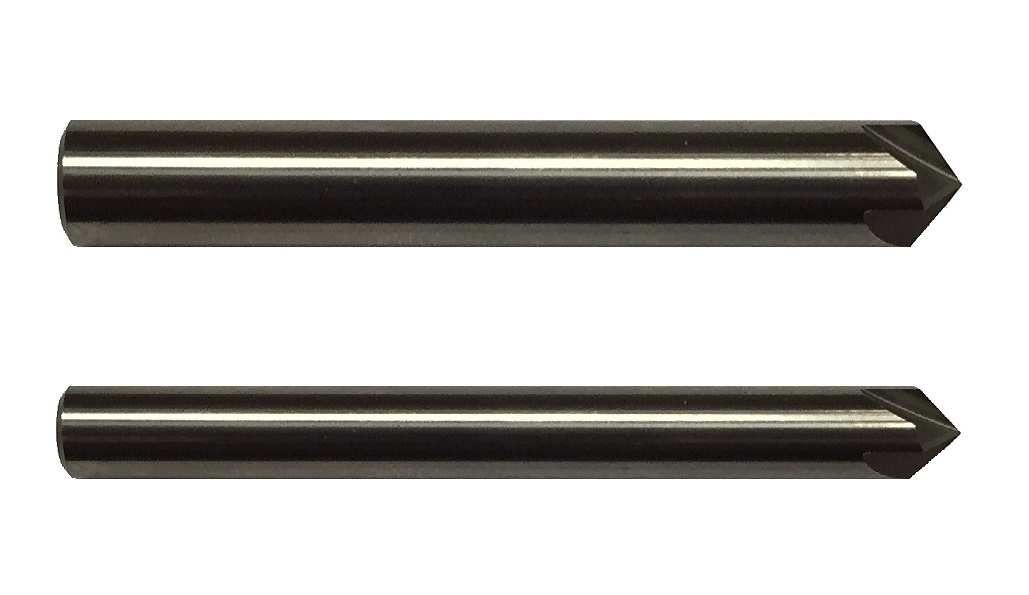
When running a milling operation, you will notice that a lot of the time it takes you to finish a piece is consumed by tool change downtime.
If you know your tools, you can always come up with more efficient uses for them. It is always better to use tools that can perform 2 jobs in one pass. Of course, it all depends on the project you are working on, and the quality of your tools.
Chamfer end mills can be extremely versatile tools. They are mostly used to take care of rugged or sharp edges giving a piece some extra strength and augmented appeal. However, their shapes and angles can serve many purposes that double those of more specialized tools, giving you more bang for your buck if you know how to use them correctly.
Here are some of the most common uses for a chamfer end mill:
When you want to cut a slot in the edge of a workpiece
The most common use for a chamfer mill is, you guessed it, chamfering. A chamfer end mill is normally used to cut just a portion of the side of a part. It creates a smoother surface, eliminating any unwanted sharpness or burrs for a more polished finish.
But you can also use this tool for beveling. The difference between chamfering and beveling is a matter of degrees. Chamfering only eliminates any 90° angles on an edge. While beveling creates a slope on the entire side of the piece. Put another way, when you only cut a sharp edge, you leave two chamfers on one side. Beveling leaves only one chamfer.
Save time with a more efficient deburring tool
Manual deburring is a time-consuming process that is hard to get right in terms of uniformity. For a faster, more automated process, adjust your running parameters to a light cut depth that takes care of imperfections left by drilling and cutting operations. Sharper tools, such as carbide chamfer end mills, will produce nicely polished walls and grooves on your parts.
Spot flush holes for dowel pins and screws
Creating a perfect hole into a part usually requires up to four different tools. We can easily cut that process in half by using a pointed chamfer end mill for spotting and leave a nice countersink angle for perfectly flush screws and dowel pins. These holes are not only aesthetically pleasing. If your work is related to the aerospace or medical industries, countersinking is a requirement.
A carbide chamfer end mill is rigid enough to provide added accuracy. This prevents the tool from walking off, giving a more precise starting point for drilling. With a clear center, you drastically reduce the chances of misaligned holes and leaves a nice angled edge for your screws to sit flush.
A word of advice here. Make sure you are using the right tip angle. Always aim for angles that are larger than that of your drill point.
Easily create slots and grooves
A chamfer end mill can also be used to create and finish slots. Carbide chamfer end mills are rigid enough to engage the material with reduced chatter with a high removal rate. If you´re working on hardened steels or alloys, programming the machine for trochoidal milling reduces contact surface radius, for better deflection and heat management. Use flat end chamfer mills for nicely polished angled corners.
If you are looking for high-quality carbide chamfer end mills, visit www.onlinecarbide.com. They have a wide selection of cutting tools, manufactured here in the US. They offer great pricing and free shipping for orders over $250. Reach out to a member of their professional team at sales@onlinecarbide.com.

