
People that don’t carry knives, or who are new to knives, often get assisted opening knives and push button automatic knives (also known simply as autos) confused.
This short post will break down the main difference between an assisted opening knife and a push button automatic knife.
An Assisted Opening Knife
An assisted opening knife has an internal spring mechanism and is designed so that if you open the blade part of the way, it will spring open the rest of the way.
It is not an automatic knife because it requires you to open the knife partly before the assisted opening mechanism takes over. In all other respects, it is the same as any other folding knife.
For instance, an assisted opening knife may have thumb studs, thumb holes or flippers for deployment, or some combination thereof. An assisted opener may also have any of the same lock types commonly used with other folders, which includes but is not limited to frame locks, liners locks, lock backs, button locks and bar locks.
One thing to note is that because assisted opening knives require an assist from you (hence the name) they are obligatorily OTS, or “out-the-side” models.
A Push Button Automatic Knife
A push button automatic knife is a knife that has an internal mechanism for deployment, and does not require you to partly open the blade for it to fully deploy.
Typically, they have a push button that is used to deploy the blade, which enables deployment to be executed completely with one hand. They may also have a lever or a slide for this purpose.
A push button automatic knife may be single or double action. If it is a single action knife, the push button will deploy the blade but it will need to be manually retracted. If it is a double action knife, the button will both deploy and retract the blade.
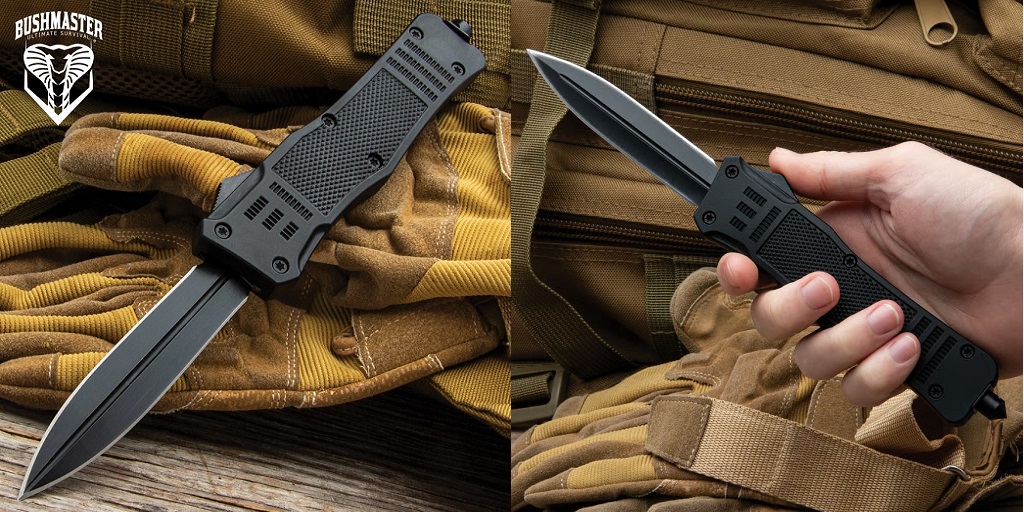
Because of these considerations, a push button automatic knife may be either an OTS or an OTF knife. As stated, OTS knives open out the side, but an OTF knife differs in that the blade is deployed directly out the front, giving the name.
Because they only require the user to press a button, many consider push button automatic knives to be more convenient and easier to use, not to mention faster, than assisted opening knives.
Explore These and More at BUDK
Ultimately, the bottom line is that an assisted opening knife, regardless of deployment, requires a small assist from you to fully deploy the blade. A push button automatic knife will not, and the button alone will be able to deploy the blade, if not deploy and fully retract it. In all other instances autos and assisted openers are the same.
To learn more about them or to explore other knives and cool stuff, visit BUDK. They carry a wide range of knives, swords, daggers and other bladed tools, some of which you won’t find elsewhere. A picture says a thousand words; visit their website today.
