
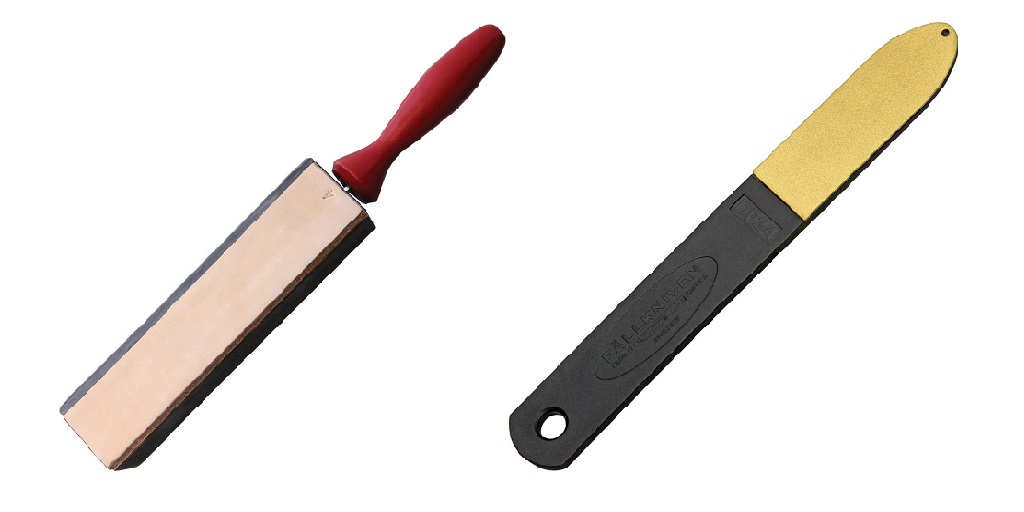
Believe it or not, there are some folk that don’t sharpen their own knives. Don’t be one of them. Knowing how to use a knife sharpener (in this case, a basic bench stone or pocket stone) is an essential skill and, as far as we are concerned, a requirement for responsible knife ownership.
A sharp knife will cut more efficiently, waste less of your energy, and cut more safely, since you won’t have to strain and will be less likely to slip. Here’s how to bring back your edge with a basic sharpening stone.
Bringing Back Your Edge
First, test your edge. An edge that is still mostly sharp but not shaving sharp will only need a touch up on a very fine grit, between 600 or 800 and 1000 (if not finer).
If the edge is not quite dull but not quite sharp, a medium grit stone will be necessary before you proceed to a fine grit; think somewhere between 400 and 600 grit.
If the edge is truly dull, almost butter knife-like, you will need to reprofile the edge entirely with a coarse stone, likely somewhere between 180 and 220 grit.
In the latter case, if your edge is very dull, you will need to restore it on the coarsest stone you have before you step up to a higher grit to refine the edge.
Preliminary note: you do not necessarily need to wet your knife sharpener; you can, and the liquid will help “float away” particles of steel swarf ground off the knife’s edge, but you can also sharpen dry. That’s your choice.
Most knives will do just fine with an edge between 15° and 20°. Place your knife flat on the face of the stone, then lift the spine about a centimeter off the stone, which should create that angle.
Push the knife forward across the surface of the stone as though you are trying to shave a small sliver off of the top of the stone.
Repeat this process 10 to 20 times, then check the edge. If you can feel a burr on the far side of the edge, it’s coming along.
Flip the knife over and repeat the process on the other side of the edge, then check it. If you can feel the edge is returning, then move up a grit to a finer stone.
If the edge needs more work, continue with the grit you are working with before you step up to a higher (finer) grit.
Once you’re satisfied with the edge you have restored, clean off the knife and knife sharpener, sheath your knife, and you’re back in the game with a sharp edge.
Where to Get a New Knife Sharpener
This article covers the basic process of sharpening a knife on a stone, from a very high level; hopefully you found it helpful.
If you are looking for a new knife sharpener, visit The Knife Connection. They carry a wide variety of knife sharpeners, including kits and stones. Shop their collection and get in touch with them if you have any questions.
