
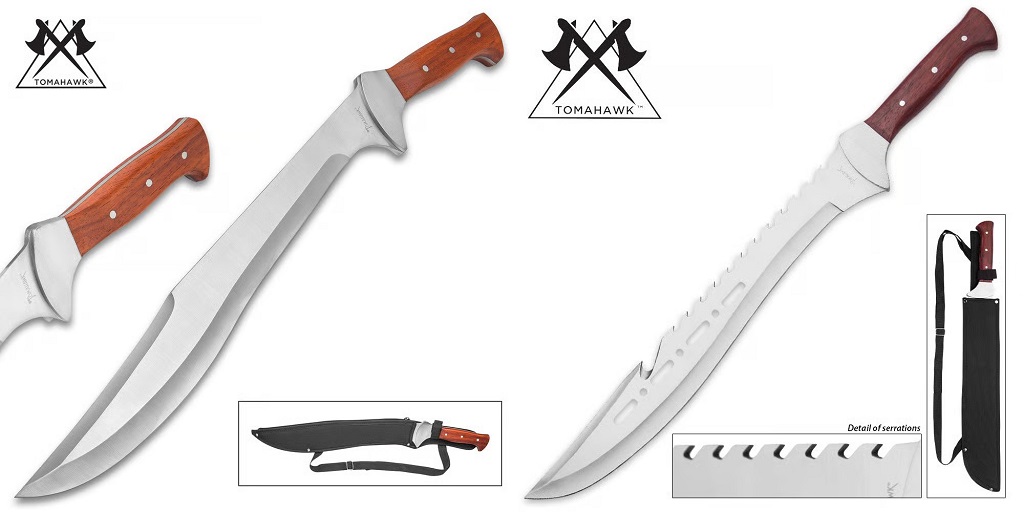
Whether you use a machete knife for keeping the yard clear, are a trailblazer that works with your state’s department of parks and forestry, or you just enjoy cutting up pumpkins and water bottles in the yard, you might think from time to time: how sharp should this thing really be?
That depends on what you use it for, and how you use it. This short post will break down some of those details.
About Edges That Are Too Sharp (or Too Dull)
The disadvantage of a dull edge should be apparent. If the edge is too dull, you won’t be able to cut through your target effectively. No other explanation is needed beyond that.
But it’s actually not a good thing if your machete knife’s edge is too sharp or too fine.
For one, an edge that is very sharp is also very fragile. It will dull fast and it might roll quickly if you use it on any hard surfaces, including wood.
Fine edges will require a lot more maintenance to keep them in cutting shape, too. On the other hand, if most of your work involves cutting woody vegetation, there isn’t necessarily a need to keep the edge razor sharp.
How Sharp Should It Be?
Your machete knife should only be as sharp as you need for the task at hand. If you are cutting water bottles and fruits in the yard, then it’s acceptable for it to be a little sharper.
If you want the machete to be razor sharp, there are two good tests you can perform. One is the hair test; simply try to shave some hairs off the back of your hand. The other is the paper test; if the blade can cut through a suspended piece of paper without tearing it, it’s sharp.
Otherwise, if all you use your machete for is yardwork, cutting through vegetation and vines, or processing wood for a fire, you won’t necessarily want it razor sharp. A few steps beneath that is more than adequate.
How to Sharpen It
There are many ways to sharpen a machete knife, but this one will look at how to do so with a series of stones.
First, to touch up an edge that’s in really bad shape, you’ll want a very coarse stone, something as low as 80 grit. You will use this to reprofile the edge.
Lay the blade flat on the stone, with the edge pointing away from you, then lift the spine until there is enough room to fit a quarter under it, so that it is raised about an inch or a little more. This will create an angle between 17° and 25°, depending on the width of the blade.
Push the blade forward, as if you are trying to shave a slice off the top of the stone. Repeat this several times, then flip the blade over and sharpen the other side before stepping down to a stone of finer grit, around 200.
Then repeat that process with the 200 grit stone, before progressing to a 400 grit stone. Repeat, then finish with a 600 grit stone.
We will not be progressing beyond 600 grit because that is more than adequate for putting an edge on yard tools; towards 1000 grit, you can make an edge razor sharp.
Here for a New Machete Knife?
If you’re here for a new heavy-duty machete knife, visit BudK first. They carry a wide variety of knives and tools, including a whole bunch of unique machete patterns. Bookmark their page and don’t miss a chance to check out what they have in stock because they are always adding new patterns.
