
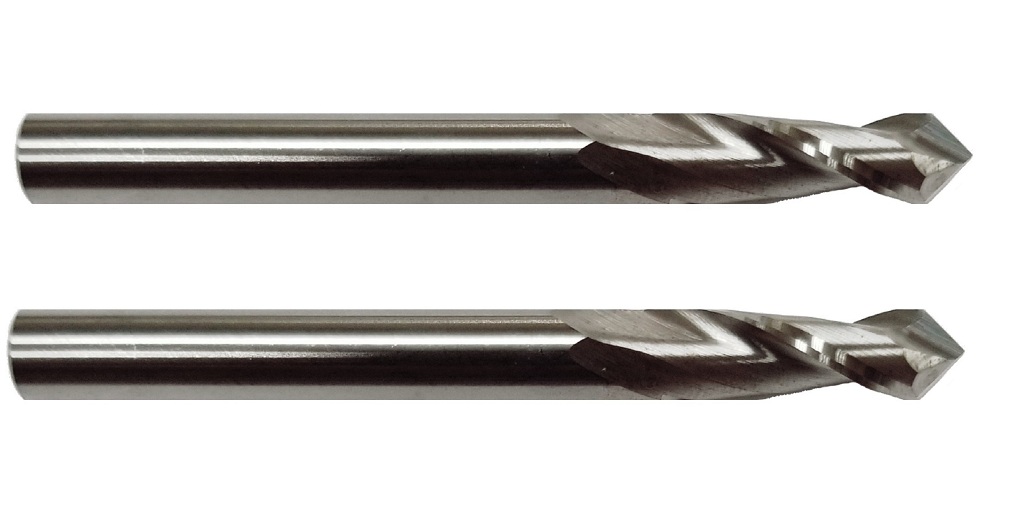
Increasing the performance of your machining operation not only means doing things faster, but also more accurately. The principle “measure twice, cut once” also applies to drilling through materials. More so because eros errors when cutting costly materials and parts could turn a whole piece into scrap.
When boring through materials, accuracy takes on additional dimensions. Complicated parts with holes from side to side need to be perfectly aligned and as close to the print as possible, especially when they’re destined for the automotive or aerospace industry where even the smallest imperfections could cause vibrations that would render the part useless.
Most shops ensure the quality of their holes by using carbide spot drills. They´re very sharp and rigid, preventing any walk-off or deflection event, and leaving a perfectly angled pilot hole to be followed by a twist drill. However, this is a two step process that tends to eat up a lot of production time, especially for shops that are not equipped with multi-spindle systems.
But, what if we could guarantee well-rounded and accurate holes without the need of spotting?
The proposition is always attractive, especially for those bent on squeezing the last drop of productivity out of their machines. However, that requires a level of accuracy that cannot be achieved with your regular jobber drill. These useful tools become unwieldy due to tensile forces; their diameter to length ratio makes them prone to wobbling. On the contrary, using small drill bits does not offer enough depth to go deep enough in many circumstances, forcing a tool change.
Here is where stub drills shine. Their name derives from the fact that they are stubby, meaning that they have a thick diameter, preserving the needed rigidness for added accuracy, but still long enough to perform full length boring operations. They are also extremely useful in cases where there is not enough spindle clearance but you need that extra reach.
Most drill bits in the market are made of high-speed steel or harder alloys like cobalt steel. The problem with these tools, even the ones with improved heads and inserts, is that they tend to be flexible making them prone to violent oscillation when driven at high speeds.
To make sure your tool has the required accuracy, you need high quality carbide stub drills. Granted, most drill jobs put a lot of tensile forces on the tip while it finds purchase. That’s why toughness also plays a massive role in our quest for efficiency. Depending on the concentration of cobalt in our carbide tools, the stub drill can be tougher and more resistant to tensile forces, improving its performance during drilling duties, while reducing the risk of fracture. Fortunately, this does not affect carbide´s rigidness enough to affect accuracy, allowing you to obtain accurate and well-aligned holes for parts that are as close to print as possible.
Coating also has a role. If you are going through hard materials like steels or alloys, you might need help with friction and temperature control. Titanium aluminum nitride coatings grant your tool extra hardness, and even increased sharpness for added material removal rates during a single rotation. They also give your tool extra protection on initial contact, rendering spot drills redundant in many cases and giving you enough headroom for improving your process.
Now, not every stub drill will be as forgiving. You need to work only with high-quality carbide tools and coatings that provide the needed stability and hardness to drive right into the material consistently without compromising accuracy. Online Carbide is an American carbide tool manufacturer committed to providing the best tools for increased performance and durability at competitive prices.
