
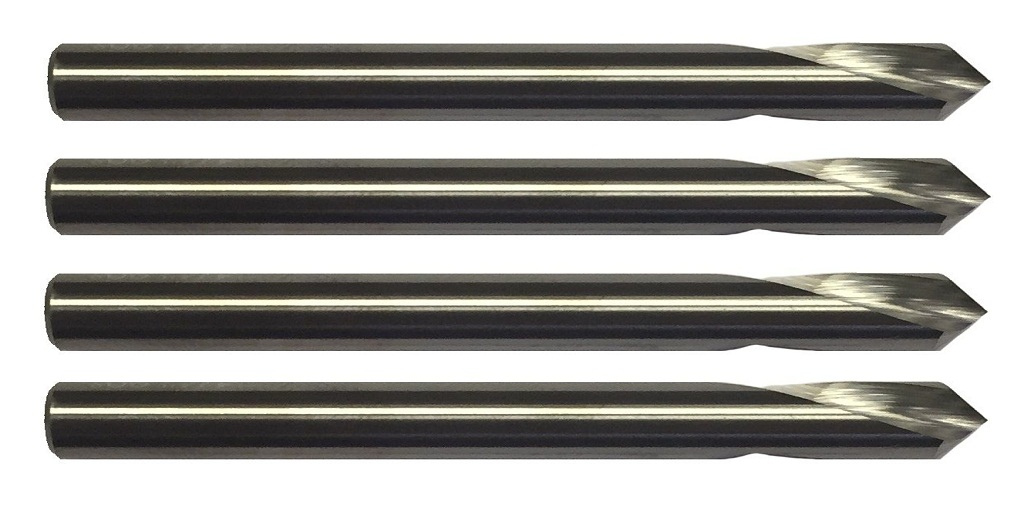
When drilling into your piece, you want your bits to follow a perfectly straight route and keep your final product true to the print. Misaligned or crooked holes can render a piece useless, making you waste time and material. How do you give your drill bits a good fighting chance to hit the true center of the hole?
Best practices require starting holes by creating small notches on the surface of the piece. These serve as a guidance that twist drills can follow a predictable vertical path and prevent misaligned holes. Two tools are typically employed for this job: Center drills and spot drills. They are the weapons of choice when you want to increase your accuracy.
However, center and spot drills work differently and have very different purposes.
Most center drills have a 120-degree angle at the tip, and then 60 degrees shoulders. This difference between the pilot and the shank diameters creates a two-level tapered hole that is excellent for fixing a lathe center to do concentric work on the piece.
Now, twist drills typically have a 118 degrees angled tip. If you use a center drill for starting your hole, the first thing you will notice is that your bit will wobble as soon as it engages with the countersink. This happens because it is almost impossible to have the drill contact all sides of the spot hole simultaneously, increasing deflection and throwing accuracy out the window.
Moreover, since the initial contact surface is not the tip but a small area on one of the sides, you risk damaging your drill bit. One solution is to only use your center drill´s pilot tip to create small notches on the surface of your piece since it has a shallower angle. However, center drill tips are extremely fragile and will fail fairly quickly if your operation requires a lot of spotting.
The best tool for the job is a 120-degree carbide spot drill. They are lightly shallower than your regular 118 degrees twist drill. Moreover, carbide tools are extremely rigid. Rigidness reduces vibration and increases accuracy even at high rotation rates, preventing your tip from walking off. They are specifically made for creating small smudges on the surface of the piece, allowing your twist bit to easily find purchase and stay aligned as you plunge it down the material.
It is easy to guess why so many machinists use center drills to start holes with their lathes or CNC routers. They feel it is made for the job, and the name can make anyone think they´re perfect for centering holes. However, their smaller point produces dimples that lack the depth and diameter to keep your longer bits in place, defeating the purpose of starting holes. Moreover, center drill tips are very fragile, making them prone to catastrophic failure in the middle of a project.
Center drills are excellent tools that have many uses. But, if you want to accurately punch holes with consistent precision while taking good care of your tools, your best bet is to use a carbide spot drill.
Finding high-quality carbide spot drills can be a bit tricky. That’s why it is a good idea to contact manufacturers with a solid reputation for offering the best tools made of solid carbide in the US. www.onlinecarbide.com offers coated and solid carbide mills and drill bits at manufacturer-direct prices. Contact one of their sales representatives and ask for their premium carbide spot drills today.
