
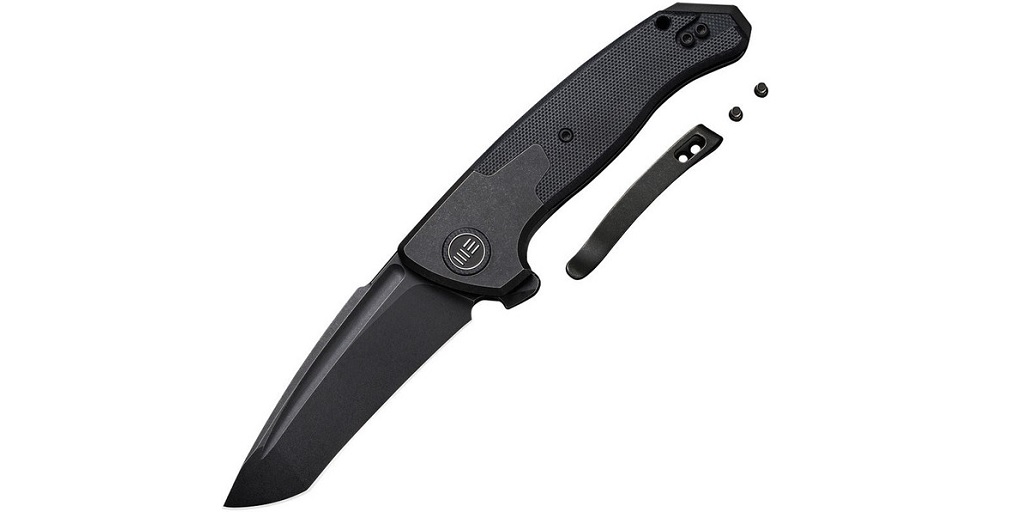
Had a Banter from WE Knife Company on you for the better part of the last few years? Has that thing not touched a sharpening stone in all that time?
Worry not – it doesn’t matter how dull your WE Knife is, as long as there’s no damage to it. You can get it back to shaving sharp with the right stones, even if it’s so dull you could use it as a spoon.
Here’s what to know about the relative grits of sharpening stones, and when and where to use them.
100 to 240 Grit Stones
These are the coarsest of all sharpening stones and will feel like rough concrete on your hands. They are used for reprofiling damaged edges, as well as for putting brand new edges on badly dulled knives. If your knife is extremely, bluntly dull, start here.
240 to 400 Grit Stones
Still aggressive, but not quite as coarse, sharpening stones between 240 to 400 grit will feel like relatively coarse, but not uncomfortably coarse sandpaper. These are used for mild reprofiling and can be used for restoring edges that are fairly dull.
400 to 800 Grit Stones
Sharpening stones between 400 and 800 grit can be used to get a relatively serviceable edge back on a knife but will not be able to make it razor sharp. These are used for the intermediate steps between restoring an edge before progressing to finer stones. They can also be used to sharpen coarser tools, like shovels, axes, and shears.
800 to 1000 Grit Stones
Sharpening stones between 800 and 1000 grit can be used to make a knife sharp, but not scary sharp. For most general applications, you won’t need to move past this unless you want to put a really fine edge on your knives.
1000 to 3000 Grit Stones
Starting at 1000 grit, you can start to make a knife really sharp. Beyond that, you’re getting into razor territory. You should not be using stones this fine unless you’re starting with a knife that has an edge that’s already in pretty good condition and simply needs to be touched up.
3000 Grit and Above
Above 3000 grit, you’re working with a stone that is used to finish wood working tools, straight razors, and the sharpest of knives. These can only be used for edge refinement and cannot be used to make a dull tool sharp. Above 3000 grit you can also use the stone to create a mirror polish.
A Word on Natural Sharpening Stones
Natural stones are somewhat unreliable in their grit ratings since no two are exactly alike. Nonetheless, a common material used in natural sharpening stones is novaculite, also known as Arkansas stone.
The coarsest of these is soft Arkansas, which is usually a white to gray color, and has a grit somewhere between 800 and 1200. Then you have hard Arkansas, with a slightly higher grit rating, followed by hard black Arkansas, which is usually between 1000 and 3000 grit. The finest of all Arkansas stones are translucent Arkansas stones, which are extremely fine and can be used for sharpening razors.
Here for a New WE Knife?
Here not for a sharpening stone, but for a new WE Knife? Get it online at White Mountain Knives. They carry a wide range of popular models including but not limited to the Banter, the Mini Buster, the Roxi 3, the Vision R, and the Miscreant 3.0.
They also carry a wide variety of sharpening stones, along with diamond sharpeners, rods, pull-through knife sharpeners, and complete kits. Visit their website to learn more.
