
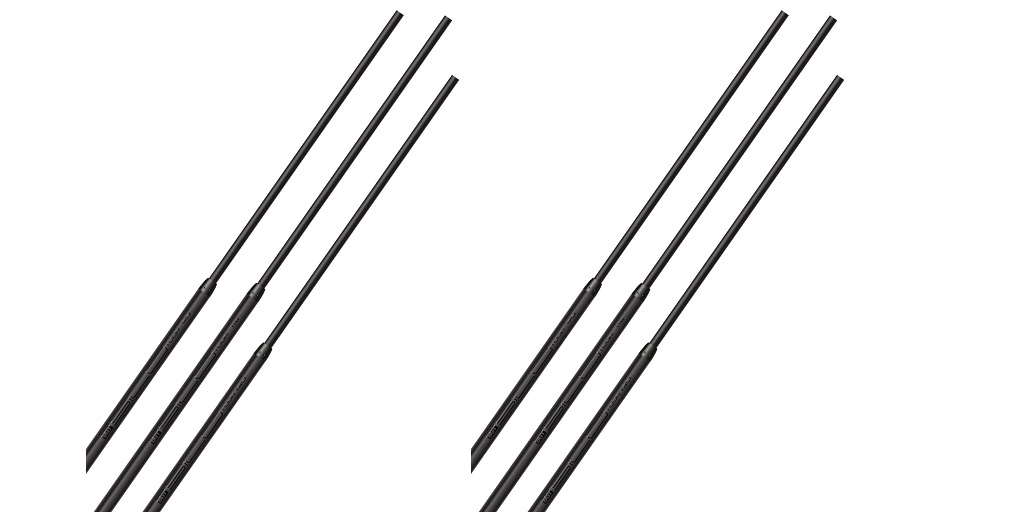
Wedges are highly specialized clubs that are typically used at very close distances from the green, usually within 100 yards of the green, and are often used to chip balls over obstacles or out of sand bunkers.
Wedges typically sport high loft and produce considerable spin to send the ball high and over short distances, helping to control rollout when the ball lands, for precision shots up close. Most wedges are marketed on the grind and spin they produce, which attributes make them more or less suitable for use on different ground conditions, such as hard or soft turf, or on sand.
With that being said, the wedge shafts that are paired with them are sometimes not given the attention they deserve, as it’s not just the club head, but the shaft that influences distance control.
Partial Swings and Distance Control
Traditional wedge shafts are made of steel. They are extremely stiff and designed for full swings. Modern graphite shafts, like Breakthrough Golf Technologies’ Silo series, are designed for distance control with partial swings.
Also known as a “half wedge shot” a partial swing is one in which the swing is partial and controlled, and in which the club only comes up to roughly chest height when swung. Very difficult to master, half wedge shots can still be crucial for making short, accurate shots without too much power, to deliver the ball a very short, specific distance, with great precision.
The truth is also that most short wedge shots, since the ball only goes so far, don’t err off to the right or left. They’re either too long or too short, which is pretty much all that matters here.
Wedge shafts like the Silo series by Breakthrough Golf Technologies are made using a multi material construction design that maximizes stability, particularly on half wedge shots, affording an unprecedented level of control within 100 yards.
For short shots, they ratchet down front-to-back dispersion for superior accuracy, and produce consistent launch and spin so that you can achieve more repeatable carry numbers and experience fewer long or short misses at those critical close distances, so near the green.
These wedge shafts also sport a “Stiffness Stack” that is 2.5x stiffer than traditional wedge shafts, and which optimizes the kickpoint for a perfect launch and trajectory. On top of this, they’re available in three different weights. There’s a 90g light weight shaft that delivers a smooth feel, a 115g midweight option that fits the widest range of player profiles, and a heavier 130g tour weight shaft that produces lower launch, lower spin, and the greatest stability.
Stop missing long and short at close ranges where shot placement is critical to scoring. If you already know how to select the perfect wedge given where the ball landed and how you need to play it, all you might be missing now is the perfect wedge shaft.
For more information on BGT’s Silo series, visit their website or get in touch with them directly at Info@BGolfTech.com for more information.
