
In the medical industry, structural equipment and electrical components have traditionally been made of metal alloys like aluminum, steel, or copper, which offer some unique balance of strength, rigidity, and electrical conductivity necessary for the given applications for which they are intended.
However, suitable as these alloys are, the improvements in medical imaging and the demand for lower-dose radiographic have spurred the development of high-tech composites that enable the production of radiolucent medical equipment, such as radiolucent ECG lead wires.
The Issue of Integrity vs. Radiolucence
Traditionally, ECG lead wires have been made with tinned copper or silvered copper conductors. These conductors offer excellent conductivity and signal quality, and they are physically fairly strong – though that latter condition is not necessarily a prerequisite for ECG lead wires.
The issue with traditional copper ECG lead wires is one of radiopacity. Copper is a relatively dense metal that, while it offers excellent electrical conductivity, is highly radiopaque. ECG leads that are present during radiography will produce bright white artifacts in the exposure.
This produces a number of problems for physicians as these artifacts can obstruct anatomical details and make interpretation of the scan very difficult. Occasionally this necessitates a retake, which is a violation of the ALARA principle.
However, the rise of advanced materials engineering has made it possible to produce lightweight, low-density, electrically-conductive composites that offer excellent signal quality while delivering all the beneficial redemptions of radiolucency.
The Value of Radiolucent ECG Lead Wires
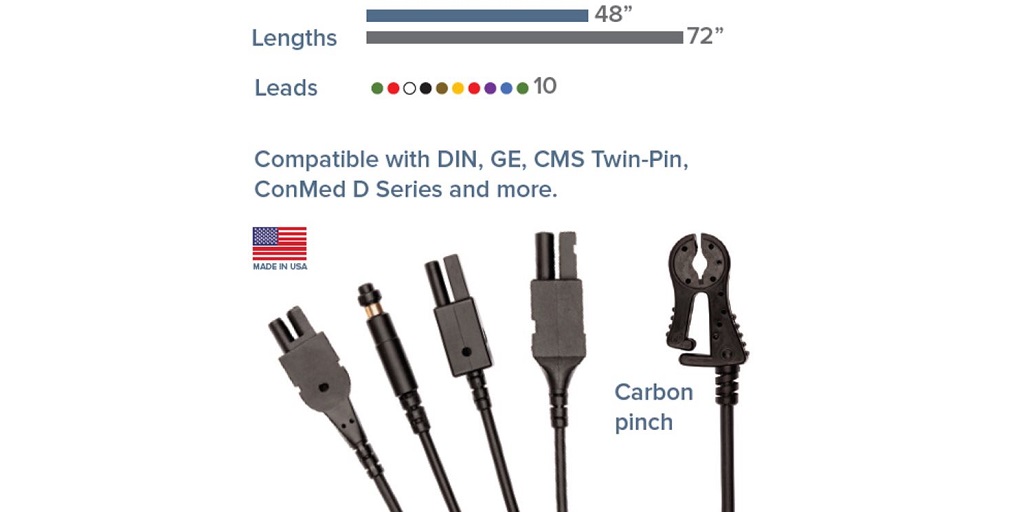
Modern radiolucent ECG lead wires are predominantly made with conductors of advanced composites, such as carbon fiber and thermoplastic matrices.
Carbon, and carbon-based thermoplastics, can be both low in density and high in flexibility and strength, retaining the necessary properties of electrical conductivity as well as requirements for modulus of elasticity.
While carbon fiber itself is inherently brittle, reinforcements with thermoplastics can make it stronger and more flexible – while still radiolucent.
This has enabled the production of high-quality radiolucent ECG lead wires that offer performance that rivals metal conductors.
Moreover, the use of radiolucent ECG leads eliminates concerns about electrode and lead wire placement, as it is impossible for a radiolucent lead to obstruct an X-ray; they offer unobstructed views of the heart.
This, in turn, makes it easier for physicians to interpret X-ray exposures and effectively eliminates the need to retake exposures due to lead wire obstruction.
These high-performance composites have revolutionized ECG lead wire production and have enabled a higher standard of medical care on multiple fronts.
High-Quality Radiolucent ECG Lead Wires and Other ECG Monitoring Equipment
For those interested in learning more about high-quality radiolucent ECG lead wires and other ECG monitoring equipment, visit LifeSync via the previous link.
For 50 years, LifeSync (formerly Rochester Electro-Medical) has paved the field with innovation and quality, and today, they offer some of the highest quality, cost-effective, reusable and single-patient use radiolucent lead wires in the industry.
For more information on their products, features, and benefits, visit their website via the link above or get in touch with them directly at 1-800-358-2468.
