
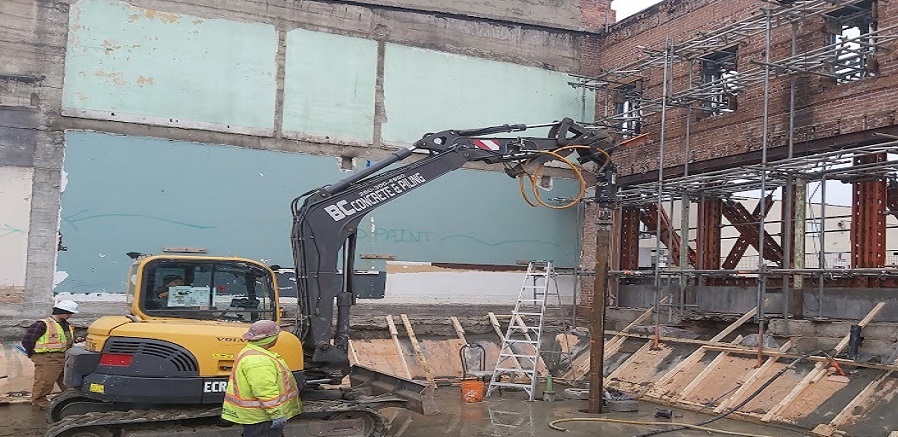
When considering foundation options for construction projects, the environmental impact is a significant factor. Helical pile foundations and concrete foundations are popular choices, but they differ substantially in terms of their carbon footprints. Helical pile solutions are versatile, quick to install, and minimally invasive. Compared to traditional concrete foundations, helical pile solutions offer distinct environmental benefits, making them a preferable option for eco-conscious construction projects.
Carbon Footprint Comparison
Concrete production is a major source of carbon dioxide emissions, accounting for approximately 8% of global CO2 emissions. The process involves the extraction and transportation of raw materials like limestone, clay, and sand, followed by the energy-intensive production of cement. For every ton of cement produced, about 0.9 tons of CO2 are released into the atmosphere.
In contrast, helical piles are primarily made of steel, which also has an energy-intensive production process but requires less material overall. Additionally, steel used in helical piles can often be recycled, further reducing its carbon footprint. The installation of helical piles typically involves smaller machinery and fewer on-site operations, resulting in lower fuel consumption and emissions during construction.
Energy Consumption and Emissions
The installation of concrete foundations requires extensive excavation, soil displacement, and the use of heavy machinery. This process consumes significant amounts of energy and generates substantial emissions. For instance, a study by the National Ready Mixed Concrete Association found that the production of ready-mix concrete emits approximately 0.82 pounds of CO2 per pound of concrete.
In contrast, the installation process for helical pile foundations is much less energy-intensive. According to a study by the Steel Construction Institute, the installation of helical piles can reduce CO2 emissions by up to 50% compared to traditional concrete foundations. The precision and minimal disturbance involved in screwing helical piles into the ground result in less soil displacement and reduced energy use, further lowering the project’s carbon footprint.
Site Disturbance and Ecosystem Impact
Concrete foundations often require extensive site preparation, including excavation and soil compaction. This can lead to significant disruption of local ecosystems, soil erosion, and long-term environmental damage. The removal of vegetation and alteration of natural landscapes are common consequences of concrete foundation construction.
On the other hand, helical pile solutions cause minimal site disturbance. The piles are installed with precision, requiring no large-scale excavation or soil displacement. This approach preserves the surrounding environment, maintains soil integrity, and reduces the impact on local ecosystems. For projects in environmentally sensitive areas, helical pile foundations are a sustainable choice.
Versatility and Sustainability
Helical pile solutions are known for their versatility and sustainability. Unlike concrete foundations, which are permanent and can be difficult to remove, helical piles can be unscrewed and extracted from the ground with minimal effort. This makes them reusable for other projects, aligning with sustainable building practices that focus on material repurposing. By reusing materials, the demand for new resources is reduced, leading to a lower overall environmental impact.
When comparing the environmental impact of helical pile solutions to concrete foundations, the benefits of helical piles are clear. With a significantly lower carbon footprint, reduced site disturbance, and superior reusability, helical pile foundations present an eco-friendly alternative for modern construction projects. By opting for helical pile solutions, builders can achieve their sustainability goals while maintaining structural integrity and efficiency. As the construction industry evolves to prioritize environmental responsibility, helical pile foundations stand out as a forward-thinking, sustainable choice.