
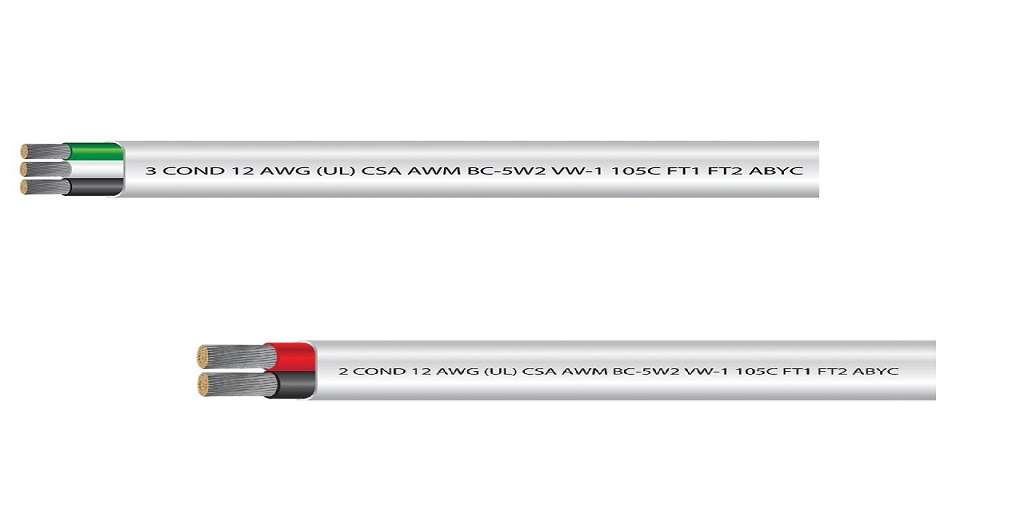
There are two things you should have noticed, if anything, about marine electrical cable. These are that it is more flexible than corresponding alternatives of the same gauge (such as automotive battery wire) and that, if you strip a little away to make connections, it looks silver.
Silver is an excellent electrical conductor, but that’s not what’s at play here. There’s something else in the mix, and this short post will shed some light on it.
Flexibility
First, let’s talk about the flexibility of marine electrical cable, which is one of its most important, defining attributes.
If you take two 6 AWG battery cables, one an automotive battery cable, and one a marine battery cable, and both have the same insulation, the marine-grade one will be more flexible. You might even consider it substantially more flexible.
Now, if you strip away some of the insulation, you will see that this is because the conductors used to make marine electrical cable are much more finely stranded than those used for other grades of battery cable. Consequently there is a higher strand count, and the cable is more flexible.
This is the “how” of the higher flexibility. As for the “why” that is more nuanced.
The reason marine electrical cable, specifically boat battery cable, is more flexible, is because the confines within the battery compartment of a boat are often much less forgiving than those under the hood of a car, and that’s saying something.
It is harder to establish and maintain solid electrical connections with a stiffer wire, and so boat battery cable is more flexible by necessity, to be able to make those bends and twists and still hold.
There is a potential added benefit that the higher flexibility means that marine electrical wire can also flex with the constant motion of a boat, making it more forgiving, but that is secondary to the fact that higher flexibility makes it easier to work with.
Corrosion Resistance
Now, when you stripped that marine battery cable and saw how many strands there were in the cable, you also likely noticed it looked like the cable was silver.
As stated, it is not silver, but it does look like it. In this case it is tinned, and not just tin, but the conductors are individually, not collectively, tinned.
Why this is the case has to do with operating conditions. As you may know, where a wire or cable is exposed, such as at a connection, it is at the highest risk of corrosive damage.
When a cable corrodes, often the corrosion does not just affect the exposed portion, but often travels up the wire or cable, underneath the insulation, eventually creating a bottleneck and then eventually shorting the circuit.
Electrical conductors on boats are even more prone to this, given the nature of a marine environment.
Fortunately, tin is much more resistant to corrosion than copper is, and so, marine electrical cables are individually tinned so that, even where the wire is exposed, it will have an additional safeguard against corrosion.
Where to Get High-Quality Marine Electrical Cable
In a nutshell, this post has explained why marine electrical cables are more flexible and why the conductors themselves are tinned.
If you are here because you are in the market for a new provider of marine-grade electrical wire and cable, get it online at EWCS Wire.
They carry a wide range of specialty electrical wire and cable, including marine-grade wire. Visit their website to learn more and if you have questions, get in touch with them at Sales@EWCSWire.com.
For More Information About Electrical Wire Wholesale and welding cable Please Visit: Electrical Wire & Cable Specialists.