
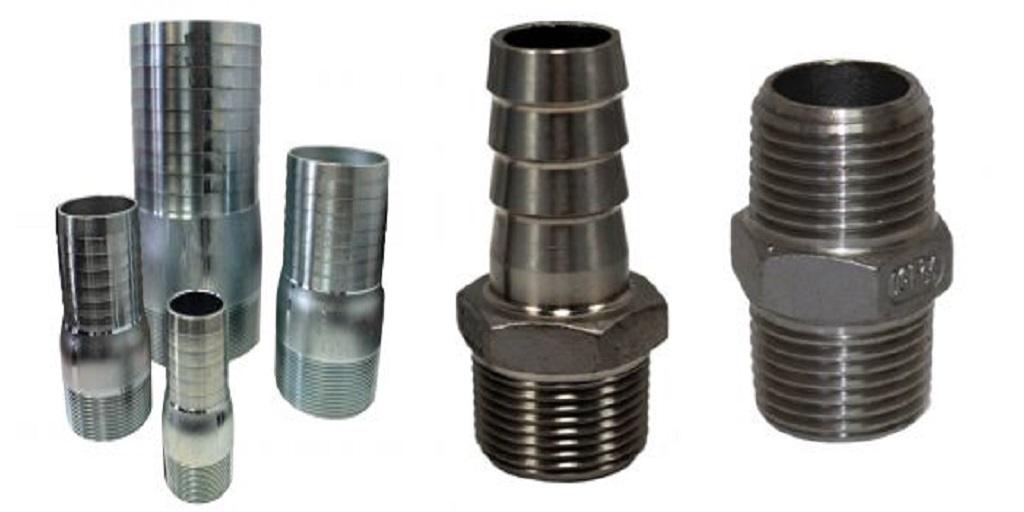
When installing pipes in a facility, regardless of what they will be used for, you have to think also about the utility of making connections between them.
There are many ways to establish connections between pipes. Some are permanent (like solder) others are quick-connects (like camlock fittings) and some are in between (like some threaded pipe fittings).
So let’s take a somewhat closer look at the advantages of threaded pipe and the fittings that go with them.
Why Threaded Pipe?
Threaded pipe gives you the flexibility to establish end-to-end connections between different sections with threaded pipe fittings (and in some instances, other types of quick-connects, but that is another matter).
Threaded pipes also represent a substantial solution to the potential problems of making these connections, as the threaded pipe fittings used with them offer some advantages over other alternatives.
Welded or soldered joints are inherently stronger, pipe threads are self-sealing and the ability to make connections easily is an advantage of its own. With that said, let’s consider the advantages of those fittings themselves.
The Advantages of Threaded Pipe Fittings
Pipe fitting installation can be either very complex or very simplistic. In the case of threaded pipe fittings, nearly anyone can establish the connection and no special skills are required. While threaded fittings are not quite as easy or quick to establish as alternatives like camlock fittings, they are still fairly simple and straightforward to establish.
Threaded fittings are also the economic option, not only because they require less labor and experience to work with, but because they themselves often represent an affordable solution.
When establishing threaded connections, less force is required, too. A simple twisting/screwing motion is all that’s needed to join the pipes, and the torque applied draws the pipes together. In contrast, when welding or soldering, the pipes must be carefully stabilized and the appropriate pressure applied while doing so.
With that said, threaded pipe fittings are not without their potential drawbacks. Though they are self-tightening, they are prone to leaking or disconnection as a result of prolonged exposure to vibration, and can be vulnerable to fatigue damage.
At the same time, there are circumstances in which the use of a threaded fitting is preferable to alternatives.
For instance, threaded fittings are a good option in applications in which alternatives (like welding) are impractical or impermissible. It also makes sense to use them where the ability to make a relatively quick connection is necessary.
Threaded pipe fittings also often make sense for use with smaller-diameter pipes and low-pressure applications. As a result, they excel at water distribution – such as in fire protection systems.
All in all, though threaded pipes and fittings enjoy a wide range of useful applications when working with liquids and gasses, including steam and hydraulic fluid, among others.
Proflow Dynamics: Your Source for Threaded Pipe Fittings and Much More
If you’re here because you’re looking for high-quality threaded pipe fittings, visit Proflow Dynamics. They carry a wide range of threaded fittings made from 304 and 316 stainless steel that are exceptionally strong and resistant to corrosion.
Perfect for fluid transfer applications in residential as well as commercial and industrial applications, Proflow Dynamics also carries hose barbs, pipe nipples, angled elbow fittings, cups, and caps made with NPT threads that are leak-proof when properly applied. They even carry flanges.
For more information on their product catalog (which also contains camlock fittings as well as stainless steel ball valves) visit their website or get in touch with them directly at Sales@ProflowDynamics.com.
