
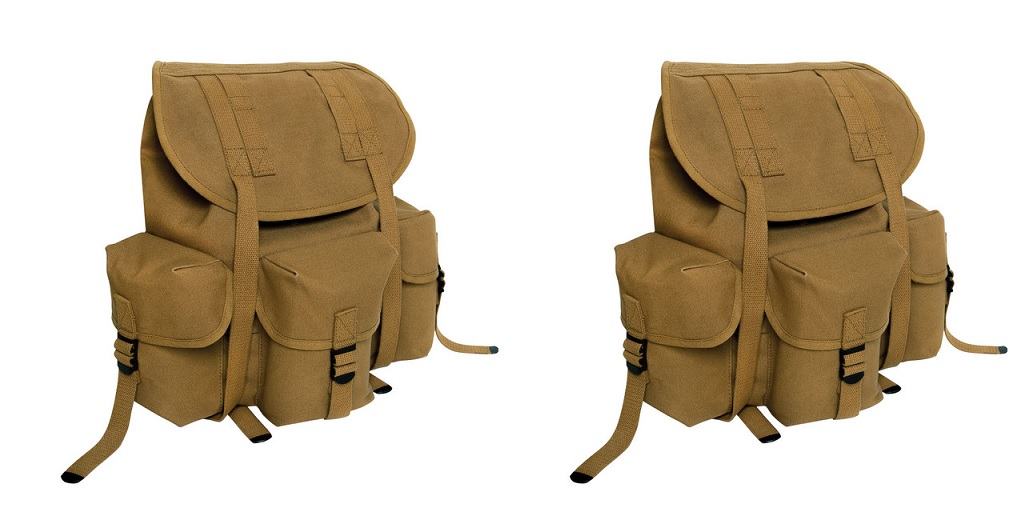
MOLLE and ALICE systems were designed by and for the United States Armed Services for the purpose of carrying equipment.
Likewise, both MOLLE and ALICE packs (and the systems they constitute) have advantages and disadvantages. Here’s a high-level breakdown of each.
About ALICE Packs (Plus Benefits and Disadvantages)
ALICE, more formally known as All-Purpose Lightweight Individual Carrying Equipment, is an equipment carrying/attachment system that was formally adopted by the military in 1973.
ALICE packs usually consist of two main components. One is the belt system, which includes suspenders as well as attachment points/carriers for entrenching tools, a canteen cover, and pouches for miscellaneous gear.
The other is the bag portion, which consists of a bag, frame, and cover. Usually, ALICE packs have large interior space for carrying bulky gear, and often the cover is waterproof or water-resistant.
One of the great things about the ALICE system is the large internal space it offers. It also has far fewer zippers (which can jam and stick) than MOLLE systems. They’re also durable and moisture-resistant.
ALICE packs are a great option for those that spend a lot of time outdoors in harsh conditions. This makes them suitable options for hikers, backpackers, and even hunters. These packs trade easier access to the gear they contain for comfort and durability.
Drawbacks? Well, the ALICE pack/system is not quite as modular or flexible as the MOLLE system is, as you will see. They can also be cumbersome when heavily loaded and depending on how much you have in the central compartment, it can be hard to access your gear.
About MOLLE Systems (Plus Benefits and Disadvantages)
The MOLLE system, which stands for Modular Lightweight Load-Bearing Equipment, was adopted by the military in 1997. The United States Armed Forces currently use MOLLE systems, as do law enforcement personnel and other officials.
The MOLLE system uses an attachment system known as PALS, which stands for Pouch Attachment Ladder System. This is often referred to as “MOLLE webbing” and consists of the loops attached to the outside of MOLLE gear.
There are numerous advantages to the use of MOLLE packs/systems. One is that MOLLE packs usually have numerous interior compartments that keep gear separate and well-organized.
The other main benefit is that this system is modular, as the name directs. You can expand a MOLLE pack by attaching MOLLE-compatible packs, pouches, and attachments, to the external PALS webbing (MOLLE webbing).
This makes it easy to customize access to your gear as well as to better distribute weight. Pouches can be attached to and detached from the MOLLE system at will wherever there are PALS loops, making it an extremely versatile, flexible system.
MOLLE systems also make it easier to store smaller items, not only in the smaller pockets but in additional accessory pouches that you can attach to the system.
As for drawbacks, there are a few, but they are somewhat subjective. If you have an early MOLLE pack with a plastic frame, be aware that these were prone to breaking.
Some users find that it’s difficult to walk through thick brush with a lot of external pouches attached. This can easily be addressed by changing the configuration of the pack’s exterior, though.
Lastly, MOLLE packs tend not to be as water-resistant as ALICE packs, although that depends on the model and brand you carry, as well as the material from which it’s made. This issue can also easily be rectified by adding a rain fly to the configuration.
Looking for High-Quality Tactical Gear?
Interested in getting a new MOLLE or ALICE pack, but want to see what options are available before you buy? Check out Fatigues Army Navy online via the previous link; they carry a ton of MilSurp and outdoor gear at great prices.
