
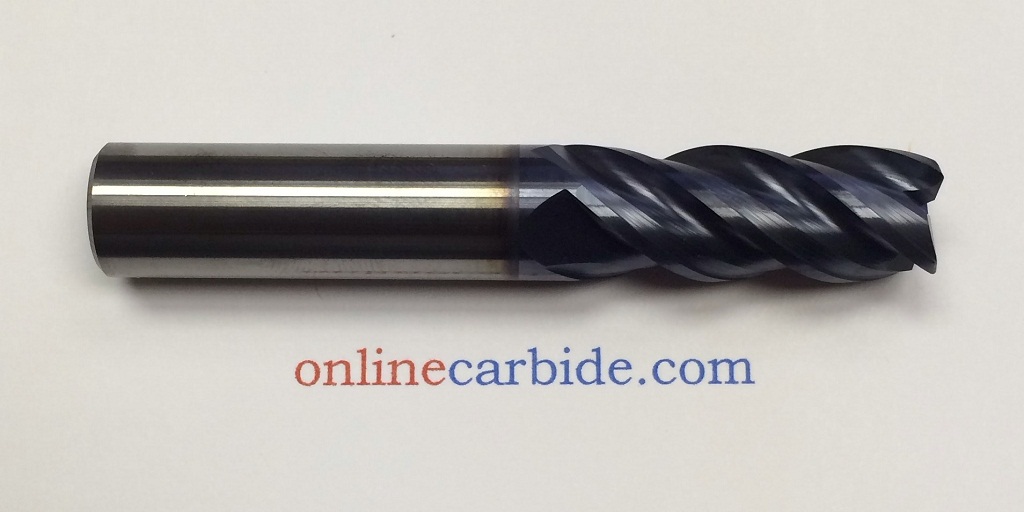
So, you want to start drilling harder materials at a fast pace and are looking into coated tools that give you an edge. You probably know by now that steel tools fail to make the cut. Their flexibility makes them wobble and walk off, they lose sharpness very quickly due to their relatively low heat resistance, or they just keep breaking.
Coated tools were designed to overcome some of these problems. However, they have their own set of rules, and you must follow them if you want to make the most of your newer and more expensive TiAlN coated end mills.
Let’s find out a bit more about them.
What are TiAlN coated mills?
Men have always tried to improve the quality of their tools. For example, iron and bronze tools were widely used in ancient times, but these metals were either too flexible or too brittle, limiting their usability. Around the 13th century BC, some civilizations discovered that iron became harder and stronger if they added carbon during the casting process, thus steel was invented.
Steel tools became a staple in the milling industry until the need to machine harder materials became imperative. This need pushed companies to design more efficient instruments capable of withstanding extreme temperatures and rotation speeds while reducing friction coefficients. Engineers and chemists discovered that coating tools with certain ceramic materials made them more durable and resistant.
Coating means applying a thin film of non-ferrous ceramic compounds to the tool surface, thus changing properties such as hardness, wear resistance, temperature refraction, surface lubricity, and sharpness.
TiAlN-coated end mills are tools that possess a very thin layer, usually 3µm, of aluminum titanium nitride on their surface. The layer is thin enough to change the tool´s physical properties without significantly reducing its sharpness. The coating is applied via physical vapor deposition, where the compound is vaporized and resolidified in a vacuum chamber that contains the tools. The material bonds directly to the surface of the mills, creating a protective coating with enhanced cutting properties.
When should TiAlN coated end mills be used?
It is tempting to take your new tools for a spin as soon as you get them. However, there are conditions that will render them useless or inferior to other drills and bits that cost less money.
TiAlN coating has very special properties. First of all, it is a high-performance coating designed for dry milling and high-temperature applications. When TiAlN runs hot, it forms a thin surface layer of aluminum oxide ceramic that enters a cycle of wear and rebuilding. This sort of regenerative property extends tool life up to ten times longer than uncoated tools, while making it harder than TiN and carbide. However, if the temperature goes down, the layer won’t regenerate, meaning that the coating will progressively wear out. It is then recommended that TiAlN tools be operated at higher speeds, up to 100% higher, than uncoated mills if you want to take full advantage of their properties.
However, it is important to remember that, while the TiAlN compound is heat resistant, the tool itself is not. So it is good practice to monitor temperatures and prevent tool fatigue as you work through large quantities of material.
Always make sure you buy TiAlN coated end mills from reliable manufacturers with quality control processes in place and offer consistent results. Visit www.onlinecarbide.com if you want precision coated carbide tools ground in the US at manufacturer-direct prices.
