
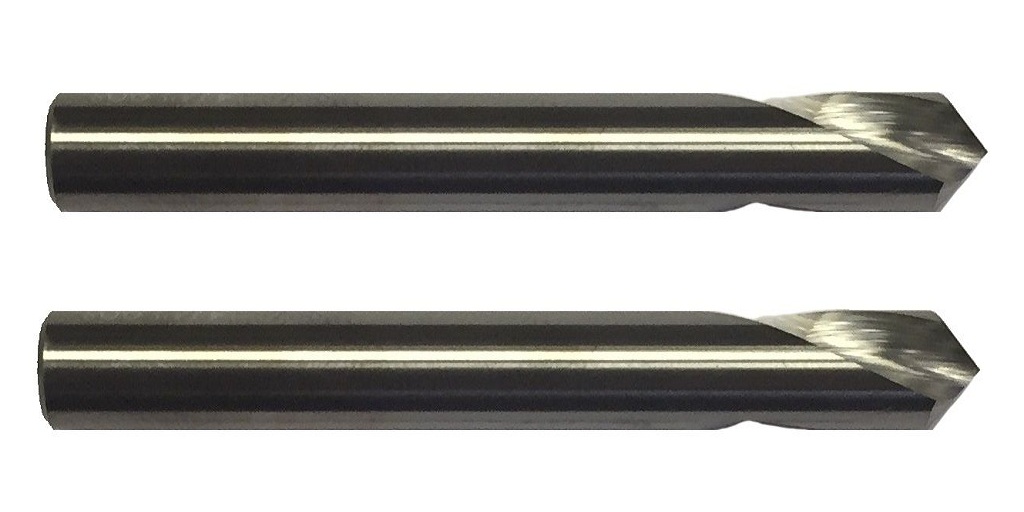
Before making a plunge cut, many machinists prep their workpiece through a practice called “spotting” to ensure that the finished hole winds up precisely where it’s supposed to. Spotting also helps improve the quality of the finished workpiece.
But what are spot drills used for and what are the best quality spotters made of?
What Are Spot Drills Used for?
Spot drills are short, stubby little drills with few (or no) flutes and very thick shafts. They are used to cut a very shallow divot in a workpiece that serves as a sort of guide for any subsequent cutting tools to be used.
Spotting with a spot drill also helps prevent two separate issues that are common when spotting is not applied: walking and deflection. Deflection is an unintended change in the course of a borehole, which can result in a curved borehole or break the drill outright.
As for walking, this occurs when the drill, which is rotating when it contacts the workpiece surface, will want to move across it laterally rather than cutting into it. This can also result in improperly placed boreholes, as well as in poor finishes or damaged tools.
Their short length and thick shanks help protect them against torsional stresses and enable them to create very precise, very consistent divots in workpieces.
It is also important to note that spot drilling should be performed with a spot drill that has a point angle that is equal to or greater than the cutting drill you intend to use. If the point angle of the spot drill is smaller than the point angle of the next drill in line, it may be damaged due to the shock loading that will occur when that drill’s outer cutting edges contact the workpiece before the drill’s point contacts the center.
Spot Drills: Carbide Cutting Tools Are Tops
If you’re here because you need to replace some of your current spot drills, carbide drills are the replacements you should be looking at.
Carbide-cutting tools, such as end mills and spotting drills, have numerous advantages over alternatives such as HSS (high-speed steel).
Carbide cutting tools stay sharper longer, can often be run at higher cutting speeds, and often are more tolerant of the high temperatures associated with machining than equivalent bits.
Because carbide cutting tools have such high wear-resistance and heat-dissipation properties, they often represent a long-term investment despite their relatively high upfront costs. They last a long time and continue to cut effectively for longer than alternatives.
Where Can You Get Carbide Spot Drills?
Long-lasting, extremely hard, heat-resistant, and efficient at high speeds, solid carbide cutting tools like spot drills are highly regarded across the industry.
If you are looking for solid carbide spot drills at reasonable prices, visit Online Carbide today at OnlineCarbide.com. They carry a wide range of solid carbide cutting tools that are made in America and select orders even qualify for free shipping. Visit their website for details.
