
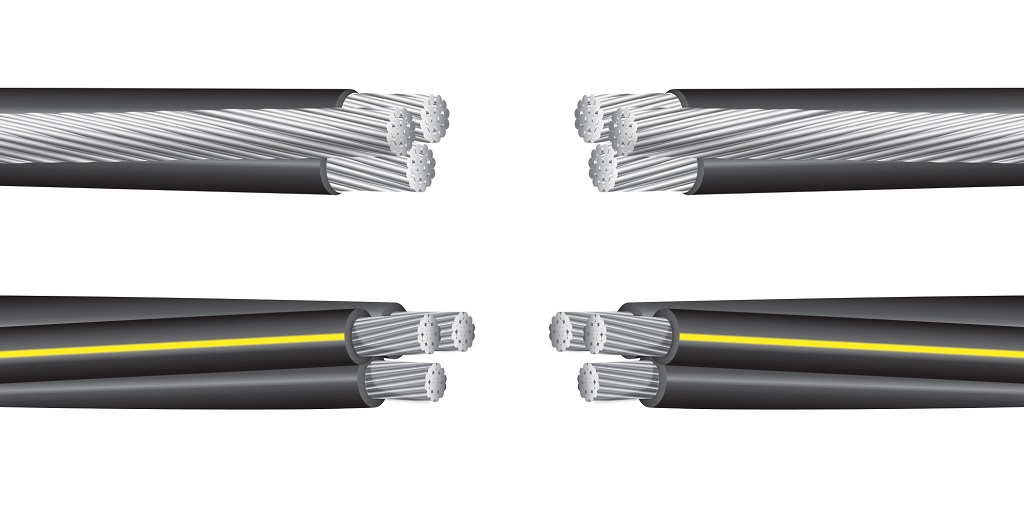
Copper wire reigns supreme in the world of electrical wire, but aluminum wire is still commonly used as an alternative, such as in the case of high-tension power lines and in aluminum triplex wire, used for electrical service entry to structures.
This short post will break down all of the relative advantages and disadvantages of each, by feature.
Strength
Copper has higher tensile strength than aluminum and is the clear winner here. This makes it easier to draw copper through conduits and make bends in the wire without it fatiguing. In fact, where aluminum is suspended aerially, such as in the case of high-tension wires and aluminum triplex or quadruplex, it is often supported by a steel member that prevents it from sagging excessively.
Weight
Copper is considerably heavier than aluminum. Copper weighs 8.96g/cm3 whereas aluminum weighs only 2.7g/cm3. Since copper is more than 3 times heavier than aluminum, it is more expensive to transport and more cost-prohibitive to install. This also makes aluminum superior for many different types of aerial installations.
Ductility
Both copper and aluminum are highly ductile and in many cases can be bent and formed without the need for special tools. However, copper can handle repeated stresses much more easily and is therefore more durable overall as an electrical conductor.
Conductivity (Resistance)
The electrical resistance of any medium is influenced by material chemistry and temperature, but regardless, copper has a lower resistance than aluminum, given the same temperature. Therefore, it offers higher conductivity and therefore voltage and current-carrying capacity, all else being equal.
Conductivity to Weight
While copper technically has a higher conductivity than aluminum, aluminum has a higher conductivity to weight ratio, which means considerably less mass in aluminum can be used, lightening the load on infrastructure (assuming it is practical to use aluminum in the first place).
Coefficient of Thermal Expansion
Aluminum has a higher coefficient of thermal expansion than copper, which means that it changes in volume more dramatically than copper when it is heated (or cooled). This is an undesirable trait in an electrical conductor as a higher coefficient of thermal expansion can implicate greater wear and tear on the insulation while also increasing the risk of overheating and fire.
Cost
The cost of copper is significantly higher than aluminum, not just as an electrical conductor but as a tradeable commodity. Therefore it costs far more to wire with copper, making aluminum a preferred material, such as in the case of aluminum triplex and quadruplex wire to be used for electrical service entry. The use of copper would multiply the cost of power distribution in residential and commercial settings by several factors.
Availability
Unfortunately there are shortages of both copper and aluminum in the United States. Despite increased demand, mining companies and manufacturers are struggling to keep up and the shortage is expected to continue into the foreseeable future, likely leading to higher prices of copper and aluminum.
Corrosion-Resistance
Galvanic corrosion can be a concern for aluminum wire, but as a general rule, corrosion is not a major concern otherwise. As a result, aluminum wires are often uninsulated, relying on air as the insulator. Copper, on the other hand, is highly reactive and prone to oxidative attack, especially in marine (and other humid) environments, necessitating special protections, either in the form of insulation or conductor tinning.
Where to Learn More About Copper and Aluminum Wire
Interested in learning more about the relative features of aluminum and copper wire? Check out EWCS Wire. They run a helpful blog with tons of useful information related to electrical wire, and they sell a fairly wide range of general and specialty purpose electrical wire and cable too.
