
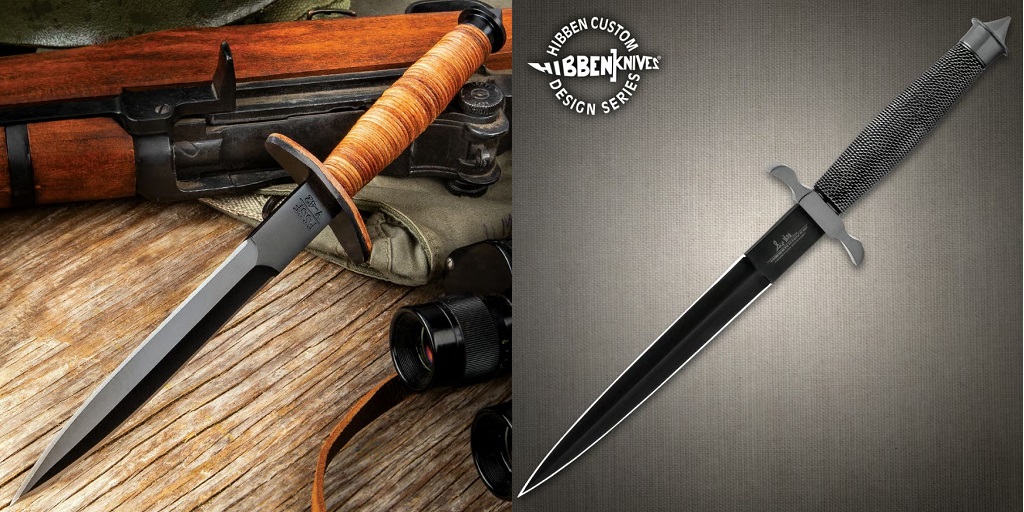
Daggers, broadly speaking, constitute a broad class of bladed tools that are primarily intended as weapons, for defensive applications. Unlike many other bladed tools, the utility of a dagger is therefore limited, and determined largely by the profile and size of the blade.
That being the case, you can tell a lot about a dagger, and how it is intended to be carried and used, from this alone.
Length
Daggers with longer, thinner blades, like dirks, were intended to be used as thrusting weapons. Those that have larger, wider, heavier blades would be more effective for slashing attacks.
However, length alone does not indicate whether or not a dagger could be effective; there are very small historical examples, like Scotland’s sgian dubh, that were sized diminutively so as to make it easier to conceal them while still retaining viability as a defensive implement.
Blade Shape
The blade shape could tell you more about a dagger pattern than any other feature. Many daggers are spear pointed, which means they are bilaterally symmetrical down the midline. This made them relatively effective at thrusting attacks and likely accounts for the majority of profiles.
Some patterns had a needle point profile, which is thinner than a spear point, but otherwise similar. These were even more effective at thrusting attacks. In fact, some were so thin they were designed to pierce tough leather armor, or even (with enough force) to split chain mail rings.
There are some wider, heavier patterns, such as the cinquedea, which hailed from Italy. Patterns like these, while they were not ineffective as thrusting weapons, offered a larger, wider blade profile that could be used effectively for slashing as well.
Edges
Many patterns, in typical fashion, had two sharpened edges, but not all daggers do. By most metrics, a tanto would be considered a dagger, but that pattern sports only one sharpened edge. Moreover, while it is a highly effective thrusting weapon, the long, relatively heavy and gracefully curved blade of a tanto made it equally suited for devastatingly effective slashing attacks.
While most daggers are sharpened on two edges, and almost all sport at least one sharpened edge, there are some patterns that are entirely edgeless. For instance, patterns such as rondels or stilettos might not have had sharpened edges at all. These daggers were designed only for thrusting attacks and would not be effective at delivering slashing maneuvers.
Other Features
Some daggers, such as parrying daggers, had elaborate or hooked crossguards. Rather than being intended as offensive weapons, these could parry or even trap an opponent’s weapon, enabling the wielder to deliver a counterattack.
Some patterns, such as the sgian dubh and in some cases, dirks, had highly decorated and ornate hilts. Though these originated as weapons, today they are commonly worn as part of traditional Highland dress. Other patterns like the kirpan and jambiya, though they also originated as weapons, are today worn primarily for ceremonial purposes.
Explore Daggers Online at BudK
Whether you’re here to familiarize yourself with dagger profiles or want to add to your collection, check out what’s in stock at BudK. They carry a wide variety of replicas including many of the patterns mentioned in passing here. Often a picture says more than a description; check out what they sell and round out your collection today.
