
What many may not know about Claude Monet’s Water Lilies is that it is actually a series of paintings – 250 to be exact – produced over a period of nearly 30 years between 1897 and 1926.
Outwardly, the series captures the bridge, water lilies, and verdure around Monet’s grounds at Giverny. Often, and because many of the entries into the series show only the surface of the water, bearing only lilies and reflections, it is said to embody the “illusion of the endless whole,” since the images contain no physical trace of bank or tree or sky.
Inwardly, however, Monet’s Water Lilies may run much deeper. During the course of his work on the series, Monet the man and Europe the entity spiraled into steep decline.
Captured in Impressionist style, with soft edges and employing techniques that make it difficult, at times, to determine where one artistic subject ends and another begins, Monet’s Water Lilies beautifully showcase the interactions between warm and cool colors while playing a game at the interpretation of reality; is the captured subject its real self, or just an illusory reflection?
There may be more to this than artistic slant. Monet may have been laboring to challenge the senses in their perception by blurring the lines between reality and impression (and literally blurring his brushstrokes), but his visual senses were also failing, literally.
During the course of his work on Water Lilies, Claude Monet was struggling against the progress of cataracts that were chronically impairing his vision.
The influence of this impediment on his vision came to a head in 1923 when the artist had an operation that resulted entirely in the loss of sight in his right eye. Yet this date should be remarkable, if only because Monet worked on the series for another 3 years.
Interestingly, Monet, the man, was not the only relevant entity that was progressively suffering at the time. By the end of 1914, Europe, and the Great Powers of the world, had descended into the War to End War.
Giverny was hardly 80 miles to the Western Front throughout the duration of the First World War, depending on the manner in which the line is cast. It is doubtless that, despite his failing vision, his hearing remained intact enough to hear the thunder of artillery rising and falling on the wind.
To him, as it did to many at the time, it must have seemed like the collapse of culture. Indeed it did, to men such as British Foreign Secretary Edward Gray, who commented that “the lamps are going out all over Europe, we shall not see them lit again in our lifetime.”
Other artists such as Thomas Hardy (who heard the guns across the channel, despite being much farther away from them than Monet) wrote: “In Time of ‘the Breaking of Nations.’” In their own ways, artists and statesmen bemoaned the failure of a common culture to save itself from mutual destruction. Doubtless, individuals like Hardy and Monet turned to art, which they knew would outlive themselves, to immortalize their grief and disappointment, while preserving some of the fighting human endurance that lies inside everyone, soldier, artist, civilian, and statesman alike.
Monet’s medium was painting. Where poets and statesmen inscribed, he portrayed, capturing an infinite likeness of nature that, though touched by man, would long outlive it, and tell a tale of infinity, everlasting determination, and beauty that survive when health and culture, individual and collective, fail.
Where Can I Get a High-Quality Monet Water Lilies Poster?
A Monet Water Lilies Poster embodies the artistic struggle against the forces of decay that wreak havoc on emotional, physical, and spiritual plains, and, being an inorganic object, is a permanent testament to resilience.
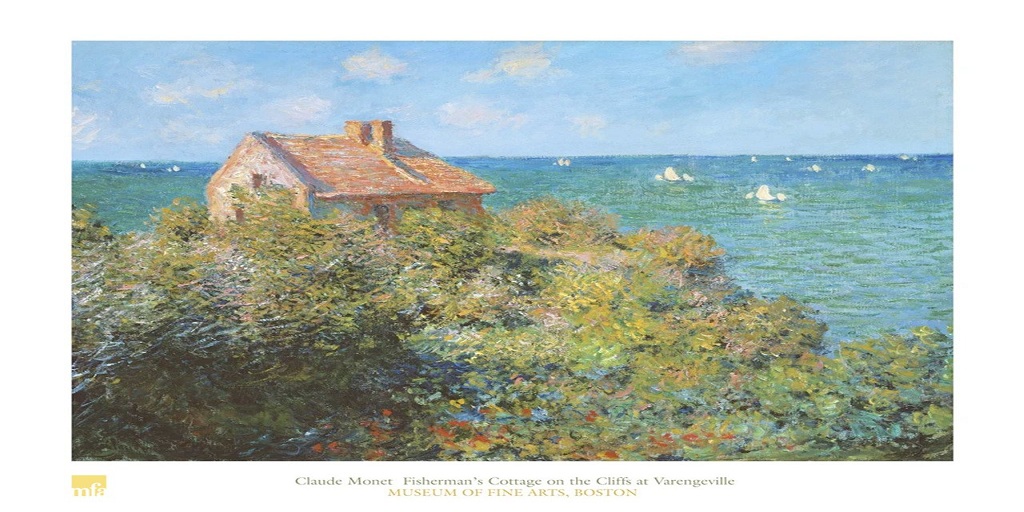
Boston’s Museum of Fine Arts carries high-quality Water Lilies posters that capture this spirit and preserve it for the ages.
If your home needs artistic revitalization, it just might make the perfect accent.
