
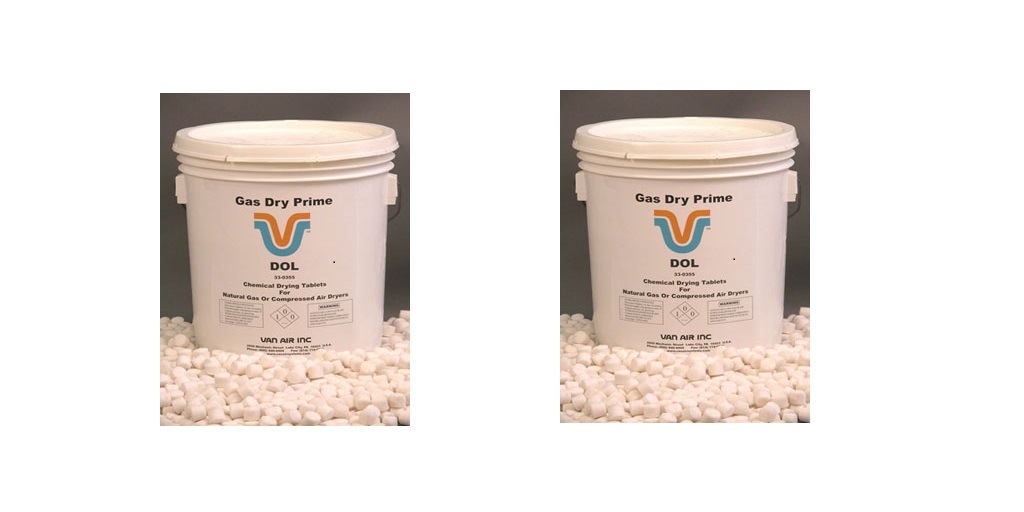
Calcium chloride, CaCl2, is a salt compound that has a wide range of economic applications. It is typically produced from limestone or by purifying salt-bearing solutions.
It is a white, powdery, or flaky substance, and its many uses range from being applied to gravel roads as a de-icing agent and even in a variety of different forms of medicine.
Calcium chloride, however, is highly soluble in water, and as a result, one of its most common applications is as a desiccant – calcium chloride desiccant, specifically.
How Does Calcium Chloride Desiccant Work?
Calcium chloride desiccants are available in a range of concentrations, typically ranging from the mid-70% ranges all the way up through 97%. It is a highly effective absorbing agent.
Calcium chloride is both hygroscopic and deliquescent. This means that it is extremely effective at absorbing moisture from an environment. In fact, it has such a high absorption capacity and it is so strongly attracted to water that it can absorb moisture from the air until it has become so thoroughly saturated that it becomes a liquid brine.
For its efficiency, it is preferred to some other types of desiccants such as silica gel. It is more efficient than silica gel and is able to absorb many times its own weight in water before it reaches its capacity.
What Is Calcium Chloride Desiccant Used for Primarily?
These types of desiccants are used in both compressed air and natural gas deliquescent dryers. Compressed air systems can be badly damaged by condensates that form within them, and natural gas systems not only can be damaged by moisture but also by compounds known as hydrates which form from an interaction between liquid condensates and hydrocarbons naturally present within the system.
Because of several natural properties and distinct advantages, calcium chloride desiccants are commonly used as absorbing agents in dryers that treat both compressed air and natural gas systems.
Does This Type of Desiccant Have Any Unique Advantages?
Calcium chloride has several distinct advantages over some other desiccants.
For instance, it is more absorbent than silica gel, and also does not contain any toxic compounds, such as cobalt. In fact, calcium chloride occurs naturally and is not considered an environmentally harmful substance. CaCl2 desiccants are fully water-soluble and many are non-toxic.
Drying systems that use calcium chloride require no energy, help prevent condensation within the system, and can be used both indoors and outdoors. These desiccants help to prevent gas lines from freezing up due to the presence of moisture.
In addition, CaCl2 helps to discourage the formation of hydrates in natural gas lines, solving two problems in one.
Not only is it environmentally sound, but CaCl2, because it is a passive drying agent, does not produce any BTEX emissions that are commonly associated with natural gas dehydration.
Additionally, since calcium chloride is often produced from natural materials like limestone or through brine dehydration, it is a much more sustainable alternative to some other forms of desiccants.
Where Can I Get Calcium Chloride Desiccant?
Air and Vacuum Process, Inc., sells a wide range of compressed air and natural gas dehydration equipment and the desiccant materials that many of them utilize, including calcium chloride desiccant.
For instance, their Van Air Type SP and Gasdry Peak Desiccant, available in both 45 lb pails, 50 lb bags, and 400 lb drums, are non-toxic, fully water-soluble, and can be used in natural gas systems to establish a relative humidity of about 33%, enabling a dew point of 30℉ lower than at the inlet of the system. It can also be used as a deliquescent desiccant in compressed air systems.
To learn more about these unique desiccants and the other systems and equipment provided by Air and Vacuum Process, Inc., visit their website at AirVacuumProcess.com or reach out to them directly at 866-660-0208.
