
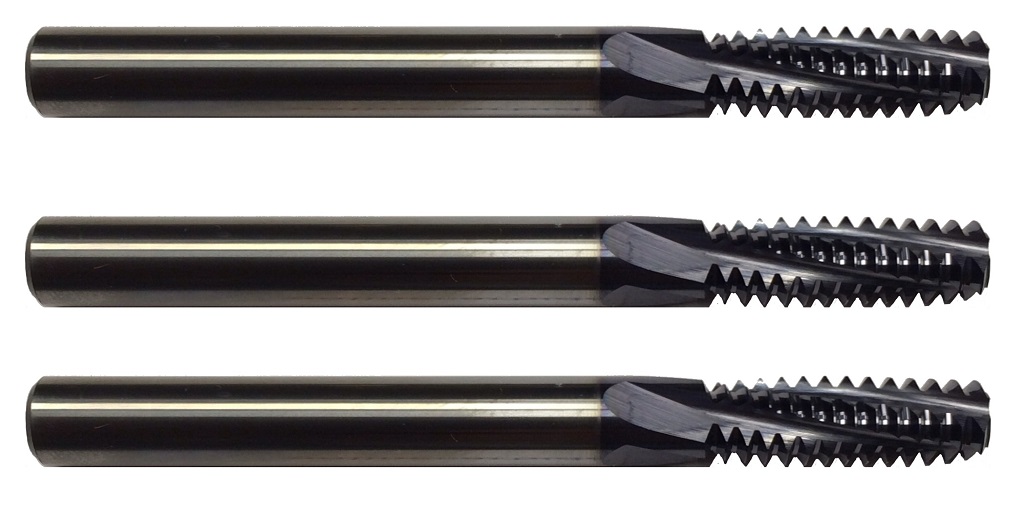
Threaded components are essential in a wide range of different applications. Whether you need to bolt two pieces of equipment together or you are attaching pipes together, threads are what makes it happen. The fact that threads are so essential in modern life means that there are a wide range of tools that can be used to produce threaded surfaces quickly and efficiently. If you are looking for one of the best ways to produce threaded surfaces, then thread milling with solid carbide tools is the perfect solution.
Thread milling, as the name implies, is the process of using a milling machine to produce threaded surfaces. Because milling machines are designed to be both fast and accurate, they are a perfect fit for cutting threads. Unlike tap and die tools or thread cutting machines, milling machines use specialized end mills for cutting out threads. Carbide thread milling tools are the clear choice if you need to cut extremely accurate threads.
Carbide tools have several advantages over their steel counterparts. Carbide tool stock itself is made by binding powdered carbide ceramic with a metal to add some strength. This means that these tools can handle extreme heat thanks to their ceramic content while also staying sharp much longer than steel tools.
One huge advantage to thread milling with solid carbide is the rigidity that these tools offer. Carbide is nearly twice as rigid as steel, which helps to prevent tools from vibrating significantly while in use. This means that carbide thread cutting tools are significantly more stable, producing extremely accurate and clean threads. For applications like pipe threading where accuracy is crucial for the final seal, these tools are a perfect option.
The fastest option when thread milling is to use a full form thread mill. These tools have rows of teeth like cutting points along its surface. These points are separated by a distance equal to the pitch of the threads that you are cutting. These tools cut by making a 360 degree pass inside or outside of the piece while dropping the length of the thread pitch. The result is that each point ends its cut where the point below it started, resulting in perfectly cut threads.
While full form tools can handle a wide variety of tasks, they are not always the best tool for the job. If you have to produce threads with different pitches or you are threading a delicate piece, then a single pitch thread mill is the best choice. These tools only have one point, which means that they have to trace along the entire length of the threaded surface. Despite the fact that it takes longer, it is perfect for mixed production or pieces with thin walls and overhangs due to the decreased cutting surface area.
If you are ready to start thread milling with solid carbide tools, then the tools available at Online Carbide are second to none. All of their thread milling tools are manufactured from solid carbide right here in the US. You can see all of their high performance tools when you visit www.onlinecarbide.com.
