
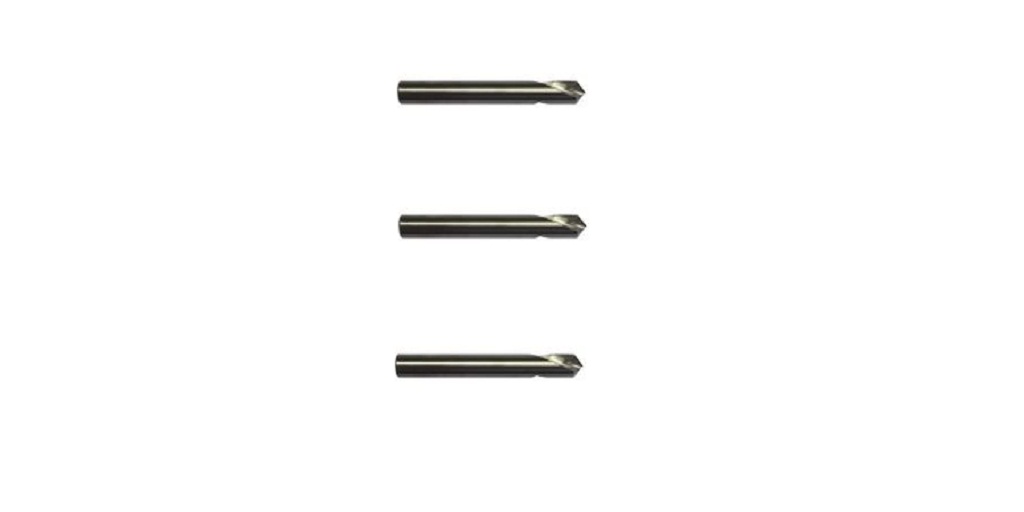
When it comes to accuracy, milling machines are truly amazing tools. They are capable of performing extremely complex operations very quickly to shockingly tight margins of error. Sadly certain longer cutting tools like drill bits are not always the most accurate when using these machines. Luckily using spot drills to your machining process can significantly improve how accurate your longer twist bits can be.
So what is the issue with drill bits? Simply put, the issue is tool vibration. All high speed tools oscillate slightly due to the centrifugal forces they are encountering. When the tool is long relative to their width like a drill bit, this effect can be a little more pronounced. This can lead to the tool having enough of an oscillation that the point of the bit will be swinging around the center of the bit’s rotation.
When a bit that is oscillating contacts a hard surface, it can deflect instead of penetrating as intended. This can even cause the drill bit to walk off its mark entirely. Obviously this is a big issue, especially when accuracy is crucial on your workpiece. One of the best ways to improve your accuracy is to create a surface that will provide your drill bit with an easier location to drill. This can be achieved through spotting.
Spotting is the process of creating small dimples on the surface of a workpiece to mark the location of future holes. The process is almost like countersinking for a hole that does not exist yet. The best tool for spotting is a spot drill. Unlike your average drill bit, a spot drill is not designed to drill deep holes. Instead, they are limited to a fluted point that is made to cut cone shaped dimples into your workpiece. These tools are short by design, which makes them extremely stable. Carbide drills are a great option because carbide’s structure is more rigid and tolerant of heat than other tool materials like high speed steel.
The process of spotting is usually quick and easy, all you need to do is make sure the spot drill has a point angle that is larger than or equal to the point angle of your longer twist drill bit. As long as this is the case, you can drill all of your spots so that your longer twist bits will hit their marks perfectly. It’s also important to make sure that you are using a proper spotting drill and not a center drill or similar looking tool that often may have a smaller point angle.
If you need high quality spot drills for your shop, then you can find some high performance solid carbide options when you visit www.onlinecarbide.com. All of Online Carbide’s tools are manufactured in America using high quality carbide stock. If you have any questions about any of the tools that they offer, feel free to reach out to a member of their team by sending an email to sales@onlinecarbide.com.
