
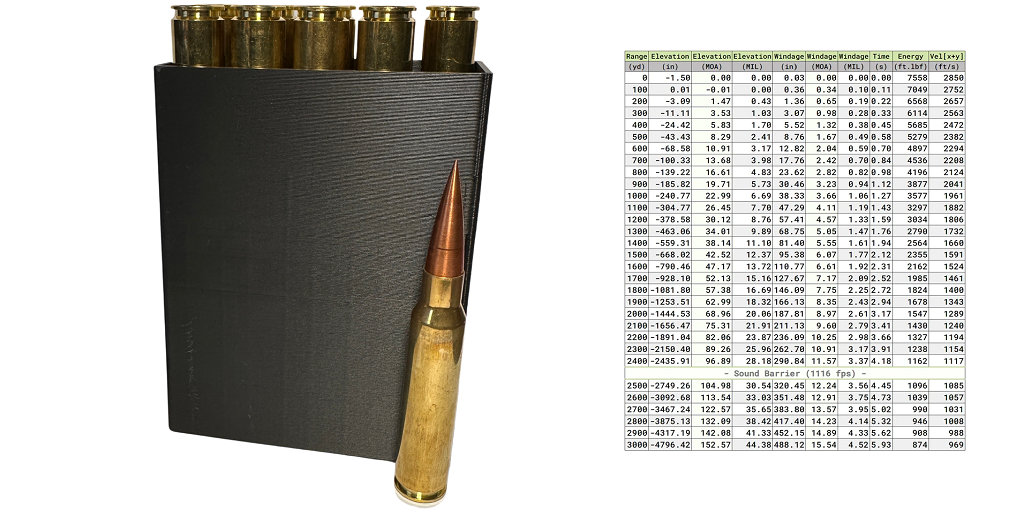
For the longest time, .50 BMG was the dominant long-range sniper rifle cartridge for the United States military, and the truth is, it is still used for a wide variety of anti-materiel applications.
But, for all its virtues, the .50 BMG is not the be-all, end-all of long-range shooting. That is precisely why Cheyenne Tactical developed the .408 CheyTac cartridge to go head to head against it, of which the .375 is a later iteration.
In several ways, both .375 and .408 CheyTac ammo outperform their larger counterpart, .50 BMG, and are excellent extreme long-range rifle cartridges. Here are three of the best reasons for that.
- The bullets CNC-machined from solid copper
Both .408 and .375 CheyTac ammo are loaded with bullets that are CNC-machined from solid copper.
Most full-metal jacket bullets, and this includes .50 BMG, are made with a separate lead core and a copper jacket.
The lead core is swaged, and then in most configurations, the bullet jacket is drawn down from the nose of the bullet towards the base.
This creates a bullet with a reasonably high degree of radial symmetry, which produces good spin stability for high accuracy at extreme ranges.
In .375 and .408 CheyTac ammo, the bullets are CNC-machined from solid copper, ensuring a higher degree of cross-sectional density and higher radial symmetry for impeccable accuracy, no matter the range.
- They’re made with “Balanced Flight Projectiles”
The bullets that .375 and .408 CheyTac ammo are loaded with are also known as “Balanced Flight Projectiles” that are designed to stay out of the transonic zone all the way to the target.
As bullets decelerate and encounter the transonic zone, they experience shock waves that can create wobble, which at any range is undesirable.
Stable and consistent, .375 and .408 CT bullets are designed to stay supersonic all the way to the target, at ranges greater than a mile, for the highest degree of stability and accuracy possible.
- They both have extremely high ballistic coefficients
The higher the ballistic coefficient of a bullet, the less it will drop at range, and the less it will be affected by wind drift, holding all else equal.
Both of these cartridges are loaded with bullets that have extremely high ballistic coefficients; in the case of the .408 it can be as high as .949, and for .375 it can be as high as .988.
They are both very flat-shooting and resist deflection as a result of wind, making them among the best ELR cartridges in the industry, especially when used for anti-material applications.
What’s the Difference Between These?
There is a lot more in common between .375 and .408 CheyTac ammo than there is that is different between them.
What it really comes down to are ballistic coefficient, bullet mass, and muzzle velocity.
The .408 CheyTac is loaded with heavier bullets and has a lower muzzle velocity and higher muzzle energy. It drops slightly faster but will deliver more energy to the target.
The .375 CheyTac is loaded with lighter bullets and produces a higher muzzle velocity and lower energy. It shoots flatter, making it a better cartridge for ELR shooting as long as stopping power downrange is not a consideration.
Where to Get .375 and .408 CheyTac Ammo?
If you’re here because you have a rifle chambered for one of these cartridges, like an M200 Intervention sniper rifle, you can get ammo online at B&B Firearms.
They carry ammo for extreme long-range rifles, as well as the rifle platforms themselves; visit their website for more information and get in touch with them if you have any questions.
For More Information About precision rifles and Cadex Chassis Please Visit: B&B Firearms LLC.
