
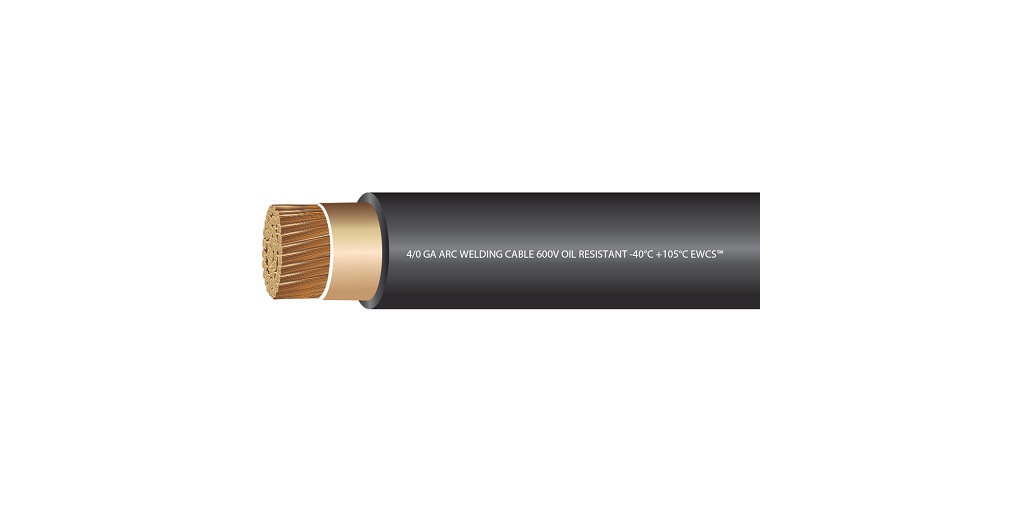
It’s no secret that 4/0 welding cable is very thick – or any 4/0 electrical cable for that matter. A cable of this gauge has a nominal diameter of .720”, almost a full inch thick.
Cable like this can weigh as much as 700 pounds, or more, per 1000 feet; in some cases, a little more or less, depending on metallurgy and insulation.
Yet, as you might be familiar, 4/0 welding cable remains surprisingly flexible. If you’re interested in how manufacturers achieve this, you’re in the right place.
So, What’s the Secret?
There is one important way that electrical cable manufacturers keep their conductors flexible, and it’s actually not that big of a secret. It’s actually something they share in common with marine battery cable.
Electrical cables like welding cable are made with many finely stranded conductors. This enables manufacturers to make the cable thicker without necessarily making it stiffer
The finer the strands of the electrical conductor, the thicker the overall cable can be made without it getting too difficult to work with.
This is critical when it comes to the actual use of the 4/0 welding cable, since it would be nearly impossible to work with a cable that thick on a jobsite without being able to position it.
Fortunately, one of the defining characteristics of welding cable, not just 4/0 cable, is that it is highly flexible.
This helps it accommodate the needs of welders, as welding must be done in situ, and as a result a more flexible cable is often necessary to meet the demands of the job site.
So the bottom line is that manufacturers make welding cables of all gauges with a high strand count and very fine conductors, which keeps them flexible.
Are There Any Other Definiting Features?
In addition to flexibility, welding cable must be made with a high-quality insulation material that is suitable for use outdoors under unforgiving conditions.
There’s not necessarily one industry standard for the material, but regardless, there are some conditions that welding cable insulation must be able to weather.
One is the weather – no pun intended. Because welding cables are often used outside on jobsites, they must be weather resistant, and this includes not just high and low temperatures, but high exposure to moisture.
Welding cable must also be UV resistant, since it is used outdoors. For this reason, some high-quality welding cables are also suitable for use as solar panel cable.
Some welding cables are made with insulation that is also oil and gasoline resistant, since these chemicals are commonly encountered in construction and on jobsites.
As a general rule, welding cables are made with high-quality, extremely durable insulation that protects them from abrasion and other mechanical stresses that might be experienced outdoors or on the jobsite.
Basically, welding cable must be made tough so that it doesn’t fold easily under tough conditions that are commonly encountered outdoors.
As a result of the level of quality to which welding cables are manufactured, they are sometimes used in other capacities, such as battery leads, and for motors, generators and in other applications as well.
Where to Get Quality 4/0 Welding Cable
Looking for a supplier of high-quality 4/0 welding cable? Start your search online at EWCS Wire. They carry an assortment of high-quality welding cable suitable for a wide range of disciplines and applications.
In addition to welding cable, they also carry a wide range of other types of specialty electrical wire and cable, including but not limited to marine battery cable, instrumentation and alarm cable, aluminum cable and much more. Visit their website for more information today.
