
Robert Eggers’ The Northman is widely recognized for taking Viking realism to a new level. Every prop, from weapons to jewelry, was built from exhaustive archaeological research. Among the most striking elements are the Viking swords: symbols of power, status, and myth.
The film’s attention to these weapons reflects both historical accuracy and cinematic precision. But how realistic are the swords in The Northman? It’s worth examining the real characteristics of a Viking sword and comparing them to the replicas that claim historical faithfulness.
The Historical Viking Sword
True Viking swords were used across Northern Europe between the 8th and 10th centuries. They were relatively short by modern standards, about 35 inches in total length, and designed primarily for slashing rather than stabbing.
The double-edged blades were broad and featured a central fuller, or groove, that reduced weight without sacrificing strength. These weapons were made from pattern-welded iron, sometimes with steel edges to improve sharpness and durability.
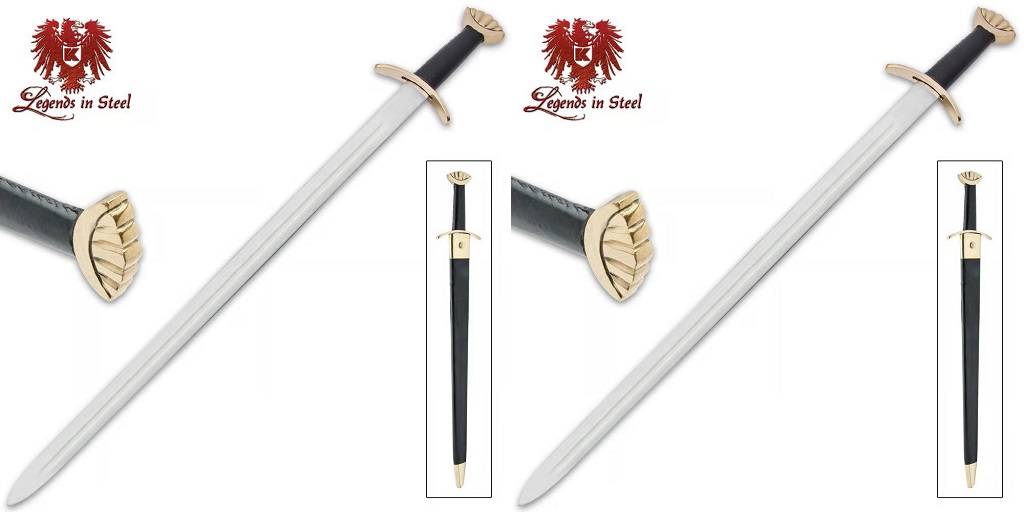
The hilt was a single-handed design, with a straight crossguard and a lobed pommel, usually three or five lobes. The craftsmanship extended beyond function, many hilts were decorated with silver or gold filigree, bone inlays, or runic inscriptions.
A sword was a mark of identity and prestige. Many had names, inherited or gifted, and carried a sense of lineage. These weren’t mass-produced weapons. They were deeply personal tools of both war and symbolism.
The Swords of The Northman
Archaeologist Neil Price, one of the film’s historical advisors, helped ensure that every weapon reflected genuine Viking craftsmanship. In The Northman, Amleth’s primary sword embodies these historical details.
It’s double-edged, short enough for close combat, and carried horizontally at the waist; exactly how archaeological finds suggest Viking warriors wore their blades. The sword’s slightly broader build and visible patterning on the blade mirror authentic pattern-welding, where alternating layers of iron created strength and the distinctive wave-like designs known from Viking artifacts.
Comparing Replicas: Which Is Closest to Reality?
Of the replicas available today, those made with high-carbon steel and modeled after archaeological finds, like those from TrueSwords. are among the most accurate to genuine Viking swords. The key qualities that make them close to the real thing include:
- Blade Structure
Authentic Viking blades had broad, double-edged blades with a single fuller. Replicas that maintain this width and central groove capture both the look and handling balance of the originals.
- Material
High-carbon steel most closely resembles the iron-steel composites used in Viking-age blades. It holds an edge well and provides similar flexibility and strength.
- Hilt and Pommel Design
The traditional three- or five-lobed pommel with a short, straight crossguard is essential. Ornate but not gaudy, these were sometimes inscribed or inlaid—replicas with subtle metallic detailing reflect this heritage.
- Grip
Leather-wrapped handles, rather than cord or synthetic materials, are both historically accurate and functional, providing the tactile control Vikings would have relied on in combat.
- Proportions
Modern replicas that stay faithful to Viking dimensions, typically under 36 inches, better reflect how compact and maneuverable these swords truly were.
Realism Achieved
The swords in The Northman succeed because they avoid the fantasy excess often seen in Viking portrayals. They are practical, rugged, and heavy with historical context. Combined with the film’s raw depiction of Viking warfare, these weapons feel lived-in, forged not for beauty but for brutal necessity.
Of modern replicas, a viking sword built with high-carbon steel, authentic hilt geometry, and restrained ornamentation come closest to the genuine weapons of the Viking Age. These qualities mirror the craftsmanship of a viking sword.
In The Northman, the Viking sword became more than a prop. It became an echo, brought to life with rare precision. Find a similar replica of a Viking sword at True Swords, to relive the weaponry of the Viking Age.