
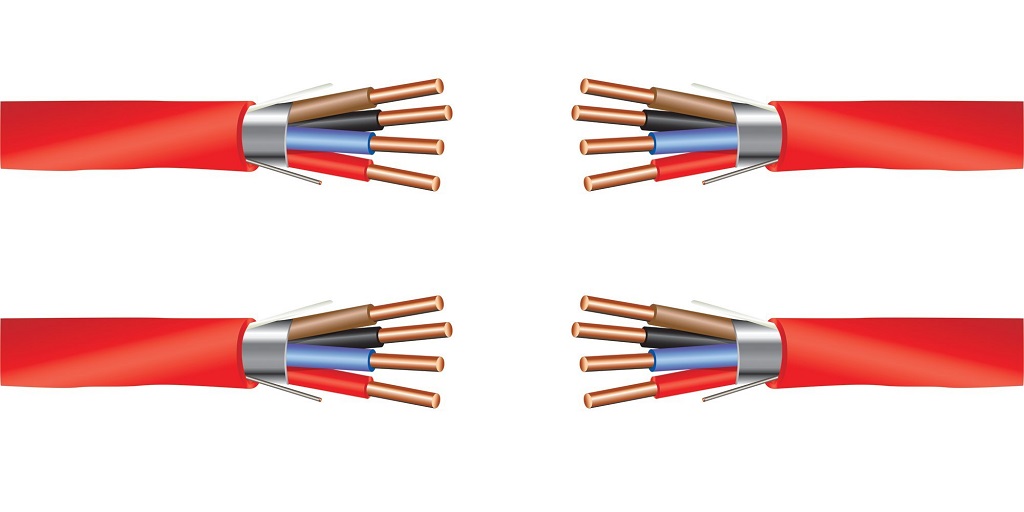
Fire alarm cables share a lot of different designators; this is something they share in common with other forms of instrumentation and alarm cables.
One of them is shielding. But what is shielding, and why does it matter?
And, does all fire alarm cable need to be shielded? Here are a few things you need to know.
What Is Shielding?
A shielded cable is basically a cable that has all of the common conductors completely enclosed within a metal braid or sheath. Commonly a thin layer of conductive metal foil is used.
There are two main reasons to shield a cable: to protect it against electromagnetic interference (or EMI) or to protect it against radio frequency interference (or RFI).
Electromagnetic interference is basically unwanted noise or frequency within a system that is produced by an outside source. High levels of EMI can actually completely incapacitate communication networks – such as those controlled by fire alarm cables.
There are many sources of EMI, some of which are manmade, and others which are natural. Some of the most common sources of EMI include power lines, electric motors, and electronic devices. Some natural sources include lightning and solar storms.
Regardless, anything that produces a powerful EMF, or electromagnetic field, is going to incur some EMI which can scramble the signal of a fire alarm cable.
As for RFI, this is any unwanted radio frequency signal that will interfere with the operation of another system. Many sources of RFI are manmade, such as transmitters, power supply switches, and other networks operating on a similar frequency.
Either way, both of these sources of interference are undesirable in fire alarm systems.
Shielding the cable in the manner described insulates it against these sources of interference. This is because a conductive layer around the outside of the conductors prevents electrical intrusion.
Shielding effectively creates what is known as a “faraday cage” around the conductors within. Because the cage itself is conductive, it incurs an equal and opposite electrical force within, canceling out the competing signals, resulting in a net zero force on the inside. This enables the conductors inside the cage to carry whatever signal they need to with less interference.
Now, while EMI and RFI can cause complete system failure, even when they do not the competing signals are problematic. They can cause data loss, data corruption, and other malfunctions. So for fire alarm system installations in which a high degree of interference is anticipated, shielded cables should be used.
It is important to note that shielding is not armor. Armored cables are protected by an outer sheath of interlocking steel (or other protective material) that provides physical protection.
Basically shielded cables are provided with protection against electrical and radio interference and armored cables are protected against physical, mechanical damage.
High-Quality Fire Alarm Cables
Did you land here looking for high-quality shielded fire alarm cables? Get them online at EWCS Wire.
EWCS Wire not only carries shielded fire alarm cables, they carry both riser and plenum rated cables along with power-limited and non-power limited versions.
They also carry a wide range of other specialized instrumentation and alarm cables, along with a variety of other specialized electrical wire and cable, such as marine battery cable, solar panel cable, welding cable, pump cable, DLO cable, aluminum triplex wire, and building wire.
For more information on the specifications of the electrical wire and cable they carry, visit their website or get in touch with them at Sales@EWCSWire.com.
