
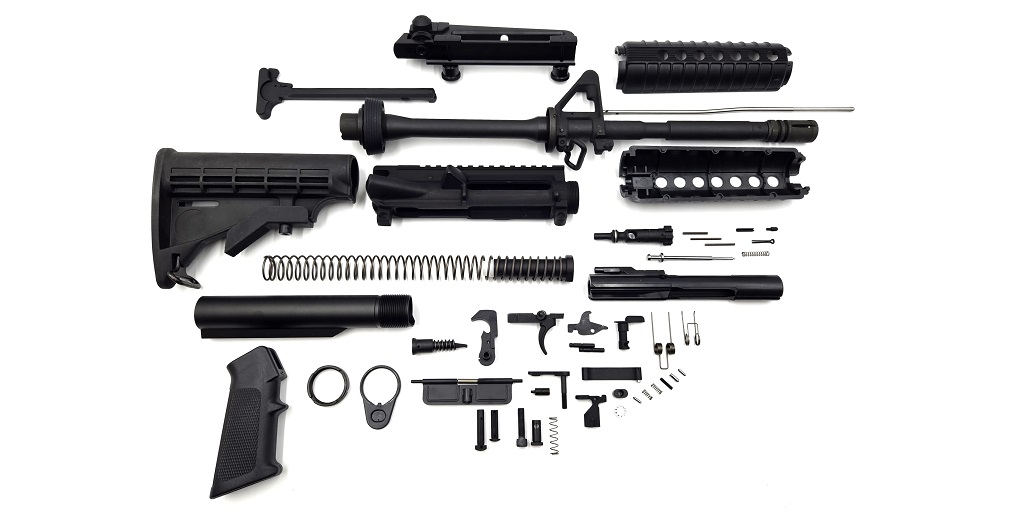
If you get a quality AR15 kit, you might not need to buy anything other than a completed lower receiver before you can assemble a functioning rifle.
This is because the lower receiver is that part that accepts the trigger group and fire control unit and as such is serialized and regulated by the ATF as an actual “firearm.”
Still, many kits contain literally everything else you need to put together an AR. There’s just one thing, sometimes these parts are mil-spec (which is not necessarily a good thing) or otherwise of specious quality.
So, if you’re building one on your own, here are some parts you might want to swap out.
The Bolt Carrier Group
Mil-spec bolt carrier groups are completed with a phosphate coating. This is a relatively tough finish that is resistant to wear and corrosion. It’s also non-reflective, which is a plus in a military role.
But, the mil-spec phosphate also has a bit of a tooth, which means it does require a little bit of extra liquid lubricant to prevent abrasion and move fluidly.
The downside is liquid lubricant also serves as a magnet for dust and dirt, which counterintuitively accelerate corrosion.
There are better bolt carrier groups with modern finishes like DLC, black nitride, nickel boron, and titanium nitride, all of which offer as good or better corrosion and wear resistance as phosphate.
But more importantly, they also offer better permanent dry lubricity, which means you won’t need to use as much gun oil.
The Barrel
There’s nothing wrong with a mil-spec barrel, but you will, at the same time, want to think about two things: length and twist rate.
With an AR15 kit, the length of barrel you get is what you get. If you want to build a rifle with a longer, more stable barrel for long-range shooting, or a shorter one, for a carbine, you’ll have to pull that off on your own.
Rate of twist, which refers to the rifling in the bore, is another thing. If you have a shorter barrel you may want a higher rate of twist, whereas if the barrel is longer you don’t necessarily need one that’s as aggressive.
Between 1:7 and 1:10 are common for AR15 rifles, but do some extra research so you can be better informed.
The Muzzle Device
Most AR15 kits will come with a flash hider, which hides your muzzle flash but doesn’t do much else.
A much better option would be a muzzle brake which will disperse the gasses at the muzzle, substantially cutting back on muzzle jump and felt recoil.
Plus, unlike suppressors, muzzle brakes are not NFA items, so they are much easier to come by.
The Trigger
The mil-spec trigger for an AR15 is just so-so. It’s a little dull and some shooters would even consider it gritty. Suffice it to say there are far better triggers out there.
Two producers that offer better options are Timney and TriggerTech. Check out what they offer on their respective websites and see if you can get a trigger that better matches your shooting discipline than a plain mil-spec one.
Where Can You Get an AR15 Kit (or Parts)?
Looking for an AR15 kit that will have all of the parts you’ll need minus the lower receiver? Check out SARCO Inc. They carry a wide range of kits and parts.
On the latter note, if you’re interested in making piecemeal optimizations to the build, they have quite a lot of AR15 and M16 parts, too. Check out their catalog and contact them if you have any questions.
