
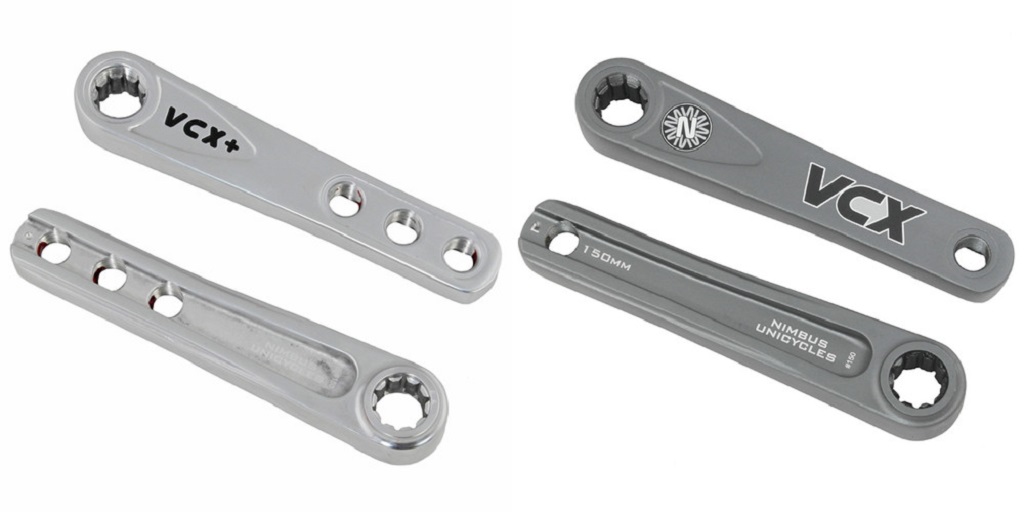
Square taper cranks, also known as cotterless cranks, are among the most common crank styles used in the world of unicycles (and bikes, for that matter, although many modern producers have moved away from them).
Recognized by the square opening that accepts the hub axle of the wheel, square taper cranks are secured by pushing into the tapered square of the hub axle, achieving a friction fit that is then secured with a nut or bolt.
These types of cranksets are popular for a variety of different reasons.
One is that they are relatively easy to produce, as compared to splined cranks like ISIS cranks. As a result, they are often a more affordable option, and one that is found on many beginner and affordable unicycles.
But beyond price, there are other benefits to the use of square taper cranks. They are relatively easy to install and secure, and offer a solid fit between the crankset and the hub axle.
Another benefit of square taper cranks is that the taper has the ability to reform itself every time you install the cranks, and the cranks can be removed and replaced countless times without developing play – as long as they are installed correctly.
Square taper cranks are also simplistic and strong. In addition, square taper spindles are usually fairly narrow which leaves more room for the brackets. Square taper bottom brackets also require very little maintenance and have exceptionally long service lifespans.
Square taper cranks also make it possible to design a cycle with a smaller bottom bracket shell, so at least in theory, a square taper crank is optimal for creating a lighter machine – even if this isn’t observed in practice. (Despite the fact that the square taper itself is heavier)
And so, despite some of the advantages of splined cranks, you can see that square taper cranks still offer competitive selling points even in the face of modern alternatives.
There are some things you should know before buying and working with them, though.
Notes for Working with Square Taper Cranks
Because of the nature of square taper cranks, if you ever install them and do not tighten them properly, you can deform the taper when riding by rounding off the edges of the square.
If you are not conscientious about this, you may damage the cranks (or worse, the hub axle) beyond repair. Therefore, one of the most important things to remember to do before riding with cotterless cranks is to tighten them properly before riding.
One more note: some cotterless cranks require a crank puller to remove them, so be aware that you may need to get one of these unicycle/bike tools if you plan to replace your current cotterless crankset.
Looking for Unicycle Crankset Replacements?
Interested in looking into replacement cranksets for your current ride? Check out Unicycle.com. Not only do they carry a wide range of splined and square taper cranksets, but they also carry pedals, tools like crank pullers, and a wide range of unicycle and bike tools.
