
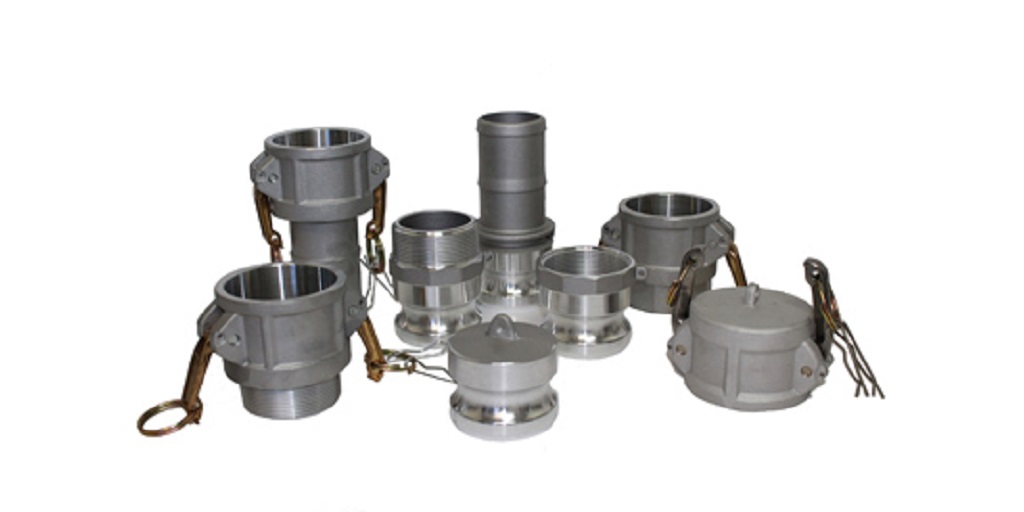
Camlock fittings constitute a class of couplings that are used to join pipes or hoses for the purpose of transferring liquids or loose materials like powder or grain. They maintain the pipe diameter to ensure a smooth, fluid flow of materials.
Moreover, camlock fittings are easy to operate by hand, with no special tools needed, and since the two halves connect to each other without the use of a threaded interface, are suitable for use in dirty environments wherein threads could become clogged or damaged, compromising the fitting.
With that said, there is still a great deal of variety in the manufacture of camlock couplings with respect to material alone, which in and of itself is a factor used to determine the suitability of a specific coupling for an application.
Let’s parse a few of the more common materials used to produce camlock couplings.
Steel (Stainless)
Many camlock couplings are made with stainless steel alloys, and the benefits of using steel are numerous. It offers high strength, corrosion-resistance, wear-resistance, and high resistance to extreme temperatures.
Because of its chemical stability, stainless steel fittings can be used in applications in which the materials transferred are acidic or alkaline in nature. Stainless steel is also easy to clean and has generally low maintenance requirements.
Stainless steel camlock fittings are commonly used in the food and beverage, fuel and oil, and pharmaceutical industries, but they can also be widely used in other industries.
Brass
While not as durable as steel, brass offers exceptional corrosion resistance in marine environments, making it suitable for use in proximity to saltwater. They can also be easier to work with since brass is a softer metal than steel. As a result of its saltwater resistance, common uses are marine applications and in deep wells.
Aluminum
Aluminum offers high corrosion resistance, which, though not on the same level as stainless steel, is offset by the advantageous low cost and light weight. Because of its performance and low cost, it has a wide range of general industrial applications.
Polypropylene (PP)
Polypropylene is a non-polar polyolefin with similar properties to polyethylene; it is very lightweight, offers serviceable chemical resistance, and is very affordable. It is also softer than metal alloys, which in some instances can make it easier to manipulate (despite resulting in lower strength). Because of its chemical stability, polypropylene, like steel, is suitable for use with acids and alkaline materials.
Nylon
Nylon is a synthetic polymer with properties similar to polypropylene, but nylon exhibits better performance in high heat, high moisture applications and environments. Like polypropylene, it is lightweight and an affordable alternative to metal alloys, and like polypropylene, since it is a soft material, is easier to manipulate.
Need More Information on Camlock Fittings?
While material is relevant to choosing the right camlock fitting for an industrial application, there are other factors that must be considered, including but not limited to size and thread type. Since the female end of the camlock is equipped with an O-ring gasket, the material used also must be considered with respect to the application.
For more information on camlock fittings for use in a wide variety of industrial applications, visit ProFlow Dynamics or contact them directly at Sales@proflowdynamics.com. The company sells a wide range of high quality fittings and ball valves across the United States and North America, and supplies numerous industries.
