
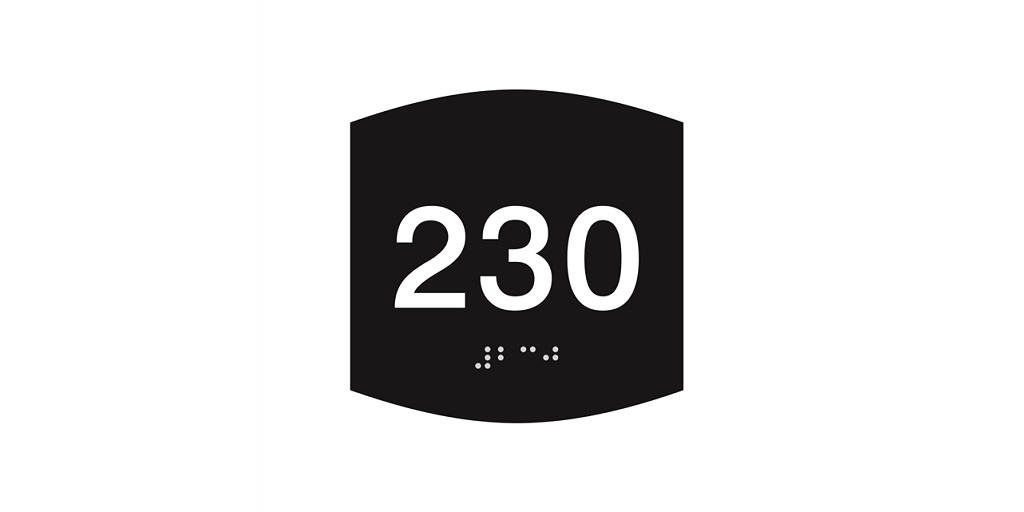
Navigating compliance with the requirements set forth in the federal Americans with Disabilities Act as well as the various state regulations across the country can feel like negotiating a minefield.
There are a surprising number of fine technicalities and non-compliance can land your business in hot water.
So, we rounded up some common questions regarding ADA room number signs, bathroom signs, and the like, and found some answers.
Where Must the Sign Be Hung?
For room signs like ADA room number signs, there actually are requirements for where and how you must hang the sign.
In most situations regarding room signs, the sign should be hung on the wall nearest the door handle, with the bottom of the tactile characters at least 48” above the floor but the top of the tactile characters not more than 60” above the floor. The center of the tactile copy of the sign should be 9” from the side of the door.
For door-mounted signs, the same height requirements are in force. However, the door must have a power-close mechanism, must not have a device that holds it open, and the sign must be mounted on the push side of the door.
Are There Color or Contrast Requirements?
Yes, ADA signs have both color and contrast requirements.
Any text or pictograms on the sign must appear in a high-contrast color from the sign background. (Braille is exempt from the contrast requirement.) In addition, the sign must have a non-glare finish.
Keep in mind that in darker areas of buildings, it is easier to read signs with dark backgrounds and lighter colors for the pictograms or text.
Are Tactile Characters Required?
Tactile characters are required for ADA identification signs, but not for informational or directional signs.
Where tactile characters are required, raised characters must be set at least 1/32” above the sign background, in an upper case, and in a sans serif font. Characters should be between ⅝” and 2” high.
Is a Specific “Type” of Braille Necessary?
Braille is not required on all ADA signs. However, where present, there are requirements for the type of braille that may be used.
Grade 2 braille must be used; it must be rounded or domed. To meet ADA braille room sign requirements, it cannot be pointed or flat. “Upper case” braille can only be used for words that begin sentences, as well as for acronyms, proper nouns, initials, or letters of the alphabet.
Braille must be positioned immediately beneath the corresponding text (for multiline text, immediately beneath the entire entry). It should be set apart by at least ⅜” and no more than ½”.
Are Pictograms Necessary on ADA Signs?
Not all signs are required to contain pictograms (which include the ISA, TTY, Voice Control Telephone, and Access for Hearing Loss pictograms).
However, pictograms are required on signs in facilities that have restrooms, elevators, or exits and entrances that are not ADA-accessible; pictograms must be placed on signs indicating those that are; signs must also be placed at those that aren’t, and indicate the location of the nearest one.
Signs with pictograms are also necessary at parking spaces, areas of refuge, and at checkout aisles.
Where Can You Get ADA Room Number Signs, Restroom Signs, Exit Signs, and More?
Looking for ADA room number signs, restroom signs, exit signs, stairwell signs, pictogram signs, and other ADA-compliant accessories?
Visit Braille Sign Pros online at BrailleSignPros.com. They carry a wide range of ADA-compliant signage and can help you find what you need. If you still have questions, visit their website or contact them at 888-297-8577.
