
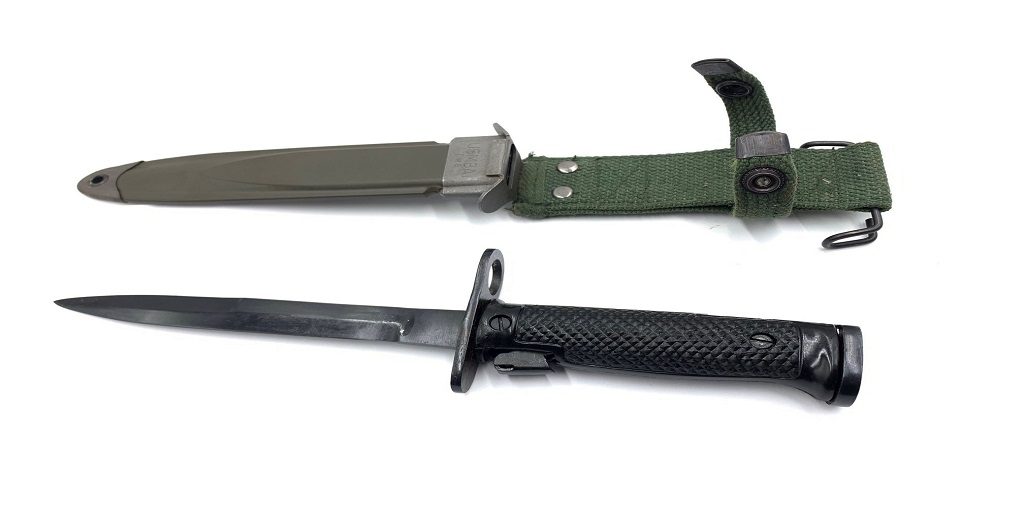
When you type M1 bayonet into the search bar, are you looking for information about the bayonets paired with the M1 Garand? Or are you looking, specifically, for the model the United States termed the “M1 bayonet”?
Because there are multiple bayonets that were compatible with the M1 Garand rifle, and the M1 bayonet (proper) is only one of them.
Let’s start, well, where it all started – with the M1905.
This is a sword-style bayonet that was actually designed for the M1903 Springfield Rifle and was predominantly produced between 1906 and 1922. It has a 16” blade with a fuller, a crossguard, and grips of walnut wood. Although it was produced for the M1903, it is also compatible with the M1 Garand.
By 1943, the changing nature of warfare indicated a change in weaponry was also necessary, and the United States shortened the M1905 bayonet’s 16” blade to 10”. This new model was called the M1 bayonet, and it is also compatible with the Garand. They were mostly produced by shortening the existing blades of extant M1905 bayonets.
There is also a bayonet that was commonly issued for use with the M1 Garand, known as the M5 bayonet. Apparently, it was difficult to mount and use the M1 bayonet to the Garand with fully gloved hands (Korea is cold) and so a new design was in order.
The United States redesigned the M4 bayonet (see below); the M5 bayonet features a 6.75” blade with black phenolic handles and, instead of a barrel ring, mounts to the Garand’s gas cylinder lock screw via a stud on the crossguard. It can be engaged and disengaged via a fairly large button.
The M1905, M1, and M5 bayonets are among the most common Garand bayonets. Now, what if you’re looking for a bayonet for the M1 carbine?
Wait, No, I Have an M1 Carbine
The original M1 carbines did not feature bayonet lugs, so instead of a bayonet, soldiers issued the M1 carbine were also issued the M3 fighting knife.
However, in 1944, the M4 bayonet (based on the M3 fighting knife) was issued for use with the M1 carbine. It has a 6.75” blade and can be fixed to the M1 carbine via a muzzle ring on the crossguard and a fastener on the pommel.
Looking for an M1 Bayonet? Or an M1905, or an M4 or M5?
Whether you’re looking for an M1 bayonet, an M3 fighting knife, or an M1905, M3, M4 or M5 bayonet for either an M1 Garand rifle or carbine, the place to visit is SARCO, Inc., online at SarcoInc.com or in their shop in Easton, Pennsylvania.
SARCO, Inc., carries one of the world’s largest selections of military collectibles, including bayonets and M1 Garand parts. If you’re looking for any of these types of bayonets, they’re a sure bet.
And, if you’re not sure which model you’re looking for (or you’re shopping for a gift for a friend that is a collector) give them a call at 610-250-3960.
