
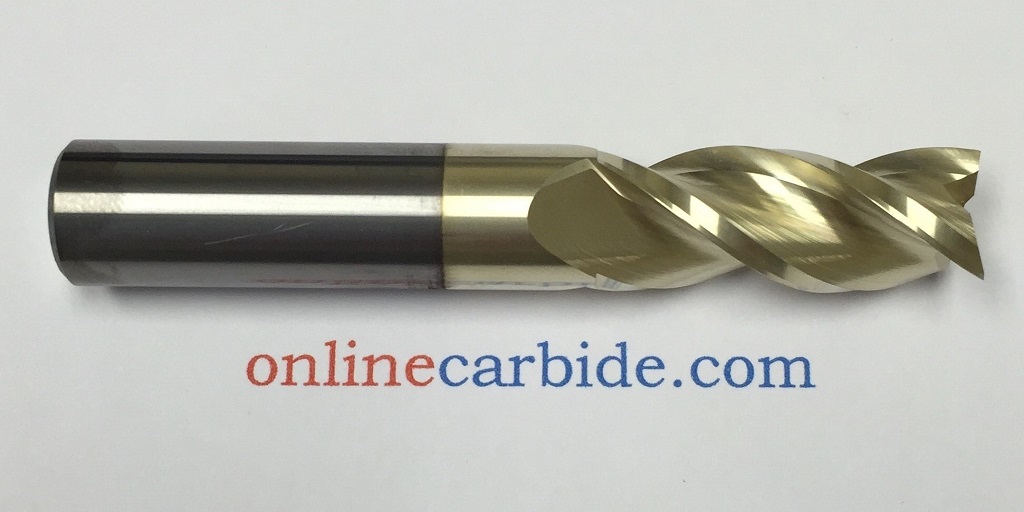
When machining hard to cut materials, carbide end mills always come up on top as the go-to tooling material, especially when our project and operation requires high levels of efficiency.
However, it is important to understand that end mills made out of the same materials (carbide and cobalt based) and even from the same solid carbide end mills manufacturer can vary in terms of performance. Why? Well, simply put because there are what we call ‘grades’ assigned to these tools. Moreover, carbide grades are not standardized, and many do not necessarily offer better milling results than others.
In this article, we’ll take a brief look at the different grades of carbide end mills available on the market and what they are meant for. We hope it offers some insights when trying to make your next milling project easier and more efficient.
What is the difference between grades?
Carbide materials usually come with very similar properties and are quite close to each other when we’re trying to compare them. This means that if we only focus on the way how a material performs in a machining environment, it doesn’t make sense to purchase a more expensive grade if we don’t get any better milling results from it.
There are four general grades that mainly depend on the intended application: turning, milling, grooving, and drilling grades.
Turning Grade Carbide tools
These differ from each other in two main ways: One is the sharpness of their cutting edges and the other is the substrate hardness. Here we find the widest variety of tools because of the extensive range of turning applications we might encounter. Operations that require constant engagement with the workpiece will benefit from increased hardness and temperature resistance, while shorter cuts usually call for more toughness to resist heavy impacts.
Milling Grade Tools
Constant interruptions natural to milling operations forces us to narrow down our selection. We tend to choose tough tools with thinner coatings that can withstand higher tensile forces. Furthermore, there is some variety between tools with different coatings. AlTiN (Aluminum Titanium Nitride) coating provides excellent temperature resistance and increases tool bit life by preventing heat from dissipating into the workpiece. TiN (Titanium Nitride) on the other hand provides very good lubricity at high temperatures.
Grooving Grade Tools
Here, speed becomes a decisive factor. As the cut approaches to the center, the diameter gets smaller, reducing cutting speed until it eventually reaches zero. At this point the tool is performing a shearing operation that requires a tough substrate to handle the forces.
Drilling Grade Tools
Drilling grades are the hardest of all, due to their continuous engagement with the workpiece. They resist high impact forces, maintain dimensional accuracy and exhibit great rigidity. This is achieved by using materials that have higher hardness and greater thermal resistance than standard turning grades.
We must remember that, when drilling, cutting speeds change as we move away from the center of our tool. If we used carbide tool grades optimized for higher speeds, they will invariably fail because of the low speeds at the center. Therefore, we choose the toughest grade for drilling applications.
If you want to learn more about tool grade and their different users, or would like to consult true expert solid carbide end mills manufacturers about the best tools for your project, visit Online Carbide.
