
Today, there is a huge demand for threaded hole-making operations in subtractive manufacturing. This means that thousands of shops use either thread milling or tapping as their preferred cutting method. However, there are fundamental differences between them, and they must be taken into account when choosing the strategy that best suits your part.
First, let´s provide a short definition for each method.
What Is Tapping?
You can cut the internal threads of your workpiece using a tap. A tap is a tool that rotates just like your ordinary drill. Its size determines the dimension of the holes it can machine, so you need specific taps to create threads in specific holes. Taps must also be plunged into holes that are smaller than the tool. This requires a lot of torque, but it is generally the fastest way to create threads.
What Is Thread Milling?
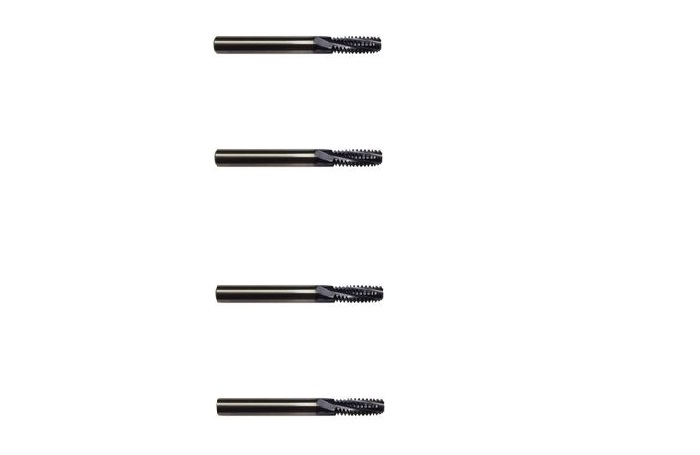
In thread milling, a single tool can be used to create threads in holes of various sizes. Solid carbide thread mills are slimmer and can have multiple cutting points or a single cutting point. Threading can be a bit slower than tapping, but it provides a lot more flexibility and higherñ-quality threads.
Now let’s find out the difference between tapping and thread milling.
Speed
Tapping tends to be faster. No question. If you are crafting threads in holes of the same size, then tapping is usually the way to go.
Full form thread milling requires the tool to do a 360° pass inside the hole to create a complete thread, and single pitch thread mills must create every single thread with each pass.
Efficiency
As we mentioned before, if your operation is monotonous in nature, you will not have a problem with taps. But if your workpieces possess holes of different sizes, or require various pitch angles, tapping can easily become a downtime nightmare.
Solid carbide thread mills can machine holes of different sizes in a single operation. If you´re using a single pitch thread mill, you can change the pitch angle on the fly without a problem. Thread milling allows you to create both internal and external threads too, reducing the need to change tools often. This not only helps you reduce tool investment but also keeps downtime cycles under control.
Thread Quality
When driving a tap into a piece, your machine needs to transmit a lot of torque. This sometimes translates into rough finishes and low component quality. Moreover, taps tend to fail inside holes, and they sometimes get irreversibly integrated into your workpiece.
Solid carbide thread mills provide incredibly precise cuts, and the sharpness of carbide edges produces excellent finishes.
Chip Evacuation And Blind Holes
Taps have grooves that help with chip removal while the cutting edges engage with the material. However, since all of the tap sides engage with the material, chip evacuation becomes a problem, causing common problems such as chip overload. Moreover, chips that can´t escape get compacted at the bottom of blind holes, requiring a finishing tool to complete the deepest threads.
Thread mills allow increased chip control and can machine the bottom of blind holes without any hindrance and in one operation.
As you can see, each method has its place in subtractive manufacturing. However, thread milling provides a lot more flexibility and produces higher quality threads while reducing downtime cycles and tool investment.
Get the best solid carbide thread mills and cutting tools from Online Carbide, an American tool manufacturer dedicated to providing high-performance workshops with the most efficient and durable tools for the job. Visit their website today or contact them at sales@onlinecarbide.com.
