
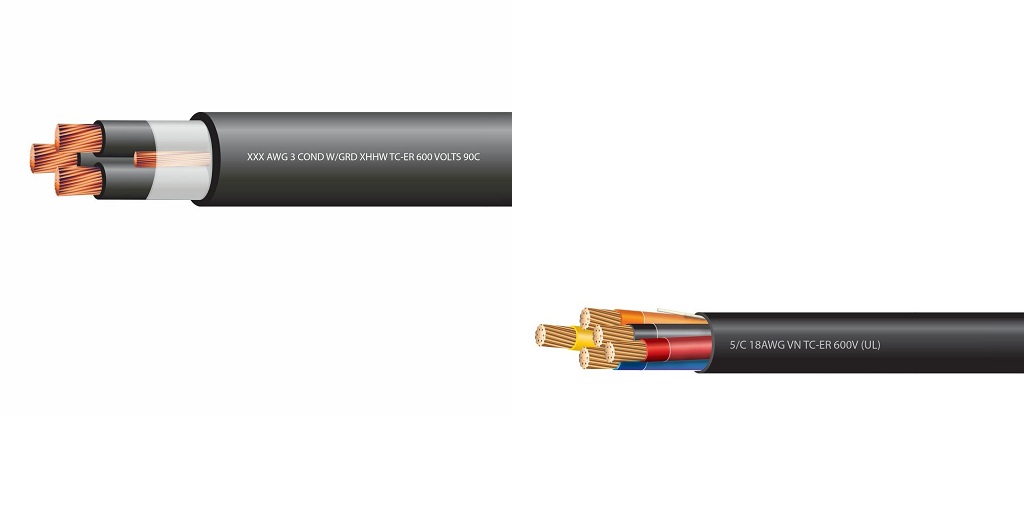
Have you ever wondered what voltage rating is or what sorts of implications it carries when performing wiring?
One of the most common all-purpose building wire ratings is for 600-volt wire, also written as 600V wire. But what does this mean, and why is it important?
What Is Voltage?
Voltage is more properly termed electrical potential. Electrical potential is the product of current and resistance. That is, how “much” electricity is flowing (the current) through a conductor and how forcefully the material of that conductor “pushes back” against the flow of electrons (resistance).
The equation for electrical potential is V = IR, where V is voltage, I is current (measured in amperes, or amps) and R is resistance, measured in Ω (ohms).
Think of electrical potential, or voltage, as how much force the electrons concentrated in one region want to flow to another region. Since electrons all have a negative charge, when they are near each other, they push off of each other, resulting in a higher net charge and a higher electrical potential.
How Is Voltage Rating Determined?
Voltage rating is determined primarily by three things: the material from which the conductor is made, the thickness of the conductor, and the type of insulator used.
Materials with very high conductive properties, like gold, silver, and copper, allow electrons to pass through with very low resistance. This means they heat up less when exposed to an electrical current.
As a result, thinner conductors made of materials with high conductivity ratings can accept higher voltage loads than similarly sized conductors made of materials with lower conductivity. For example, a 12 AWG copper wire would have a higher voltage rating than an iron conductor of the same gauge, because iron is a poor conductor. This illustrates how both material and thickness affect conductivity rating.
The material used to create the wire insulation is also critical in determining the voltage rating. The better the material blocks out competing electrical currents and prevents electrical charges from arcing away from the wire and to other materials, the higher the voltage rating of that wire will be.
Commonly used materials for electrical insulation include but are not limited to PE (polyethylene), PP (polypropylene), PUR (polyurethane), nylon, PVC (polyvinyl chloride), and EDPM (or ethylene propylene diene monomer).
Is It Safe to Exceed Voltage Ratings?
It is not safe to exceed the voltage rating of a conductor. Doing so entails a number of risks. For instance, exceeding the voltage rating increases the risk of arcing.
More importantly, exceeding the voltage rating of a material increases the risk of overheating the wire, which creates a huge fire risk. Electrical fires are a concern in many industries, in commercial settings, and in residential settings as well – therefore, it is important to be aware of the limitations of electrical conductors and never to exceed them or to use the wire in a manner inconsistent with the recommendations of the National Electrical Code (NEC).
What Is 600 Volt Wire Used for?
Most general-purpose building wire is rating at 600 volts, so many different types of wiring used in residential settings are used for such purposes.
Because most residential electrical services are supplied at 120 volts, 600-volt wire is commonly used in homes and other residences because it well exceeds the requirements of such service. Even high-voltage appliances like HVAC systems typically do not require more than 480-volt service.
Where Can I Get 600 Volt Wire?
The good news is that 600-volt wire is not a rarity. It is relatively easy to find 600-volt building wire. If you’re looking for general purpose building wire, we suggest looking online at EWCS Wire (EWCSWire.com).
They carry a wide range of general-purpose wire in addition to specialty wire and cable such as marine battery cable, flexible welding cable, PV solar cables, instrumentation and alarm cable, and much more.
Check out their website today or contact them at 800-262-1598 for more information.

