
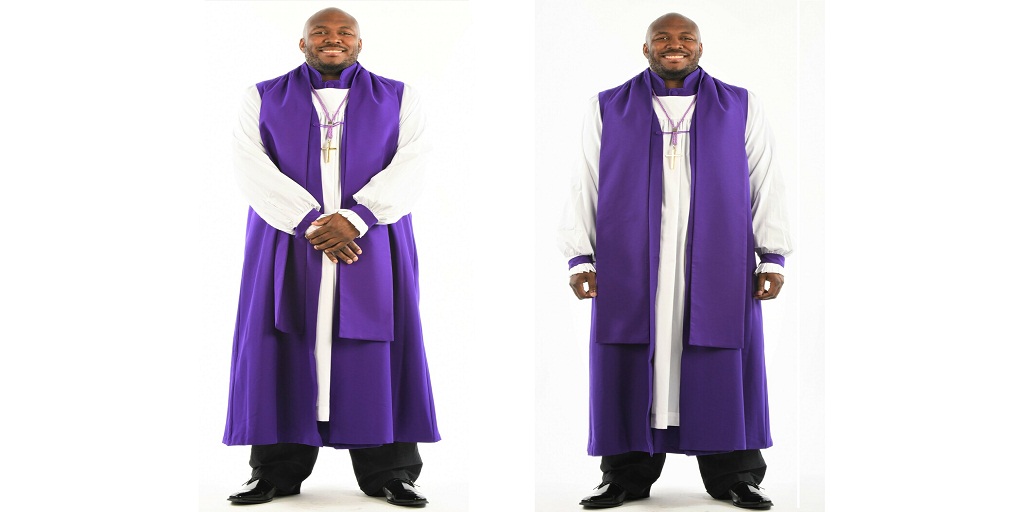
The chasuble is an integral component of the bishop’s garments. If you don’t recognize the name, you’d almost certainly recognize the sight of one.
This is the somewhat-capelike garment worn by bishops over the alb and stole for the celebration of the Eucharist. It is worn draped over the shoulders and in the case of bishops, it is commonly colored purple.
But what is the origin of the chasuble – where did it come from, and why do bishops wear them?
Name Origin
The name “chasuble” comes into English from the Old French of the same word, alternatively spelled “chesible.”
This in turn derives from the Latin “casubla” or “casula,” both of which which connote “a little cottage or house,” or alternatively “a hooded cloak.” These words themselves are extractions of the Latin “casa,” for “house,” which is still extant in several Romance languages today.
A Historical Insight Into This Unique Bishop Garment
The chasuble likely originated as a nondescript ovoid piece of cloth that was worn as an outer traveling garment in the time of the Late Roman Empire. The earliest “chasubles” likely reached lower than the waist – nearly to the wearer’s ankles. Like many other modern vestments, it’s likely that the chasuble’s origins were secular.
Originally, the chasuble covered the wearer’s arms and had to be gathered up around the sides in order to allow the wearer the free use of his arms. Over time, and after the garment was absorbed into liturgical use, it became customary to tie up the sides to allow the cleric to use his arms.
Eventually, the custom became to produce garments that were shorter at the sides, enabling more liberal use of the arms. It was also reimagined with a shorter front and back, reaching only to the waist instead of to the ankle.
By the end of the 1500s, chasubles were commonly produced with substantially shortened sides, fronts, and backs. These garments covered the shoulder blades and draped down along the front, nearly to the wearer’s waist, but left the arms almost entirely free.
In more recent times, there has been a movement to reinstate the popularity of the earlier forms of the chasuble that are not only longer at the front and back but also at the sides.
Though the chasuble is worn as a priest’s vestment in Protestantism, not all churches make use of it. Among Protestants, is in most common use among the Lutheran and Anglican churches. In Roman Catholicism, the chasuble is one of the most central Mass vestments, being described as symbolic of the “Yoke of Christ.”
What Other Bishop Garments Are Frequently Worn?
In addition to the chasuble, it is commonplace for bishops to wear a variety of other clerical vestments, including but not limited to:
● An alb or rochet (a white linen garment)
● A stole
● A cassock and fascia (similar to a cincture)
● A simar or mozzetta
● A ferraiolo
● A miter, biretta or zucchetto (all headwear)
● A vimp
In addition to these vestments, a bishop’s garments are often accompanied by the bishop’s pectoral cross, bishop’s ring, and the crozier, the traditional staff of the office.
Where Can You Find Bishop Garments and Other Clerical Vestments for Sale?
Interested in learning more about bishop’s garments like the chasuble, or looking for other traditional bishop’s and clergy attire such as clergy shirts and clergy robes?
Look no further than Divinity Clergy Wear, online at DivinityClergyWear.com. They carry a wide range of bishop’s garments and other clerical attire, as well as approved COGIC Class A vestment sets. Visit their website today for more information or contact them directly at 877-453-3535.
