
CNC machining, with its precision tolerances and highly specialized end mills, is not an operation in which “good enough” is ever “good enough.”
The tools you choose to use, and the speed and conditions under which you operate them, must be very carefully selected for the application.
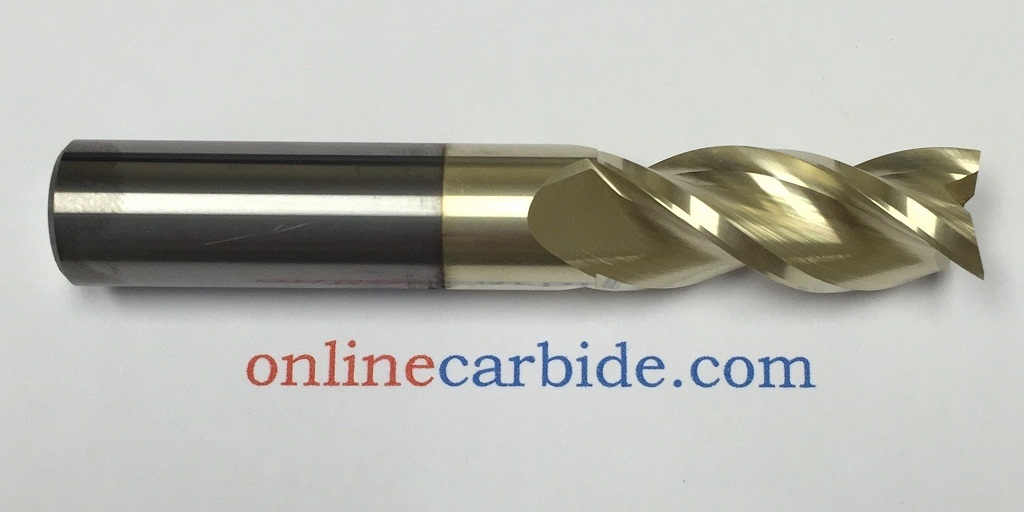
Case in point: end mills for sale, and the great variety they exhibit, not only in terms of material, size, and coating, but in length, profile, number and type of flutes, teeth, and more.
Here we’ll look at two of these attributes with the intention of reflecting on how they make an end mill more or less suitable for a given application.
Number and Type of Flutes vs. Application
The number of flutes is arguably one of the most important considerations you can make when choosing an end mill for a cutting application.
The flutes are the raised edges along the margins of end mills, that bear the teeth (where present). End mills may have two, three, four, or more flutes – some have as many as fourteen.
Two and three flute end mills are best suitable for non-ferrous materials because they have the most negative space between flutes and allow for greater chip clearance and easier evacuation.
The advantage of 2-flute mills respects enhanced chip evacuation, but 3-flute mills are superior for finishing because there is more contact with the flutes and the material.
End mills with more than three flutes are the better choice for milling applications when ferrous materials are involved.
Flutes with anywhere from three to five flutes are the traditional choice for roughing because there is more flute valley space for chip clearance and evacuation, while the mill is still structurally sound enough to withstand the rigors of roughing ferrous metals.
For slotting purposes, some prefer a four-flute mill, as these mills still allow for decent chip clearance.
Finishing applications in ferrous materials require the highest flute counts of all. The enhanced contact between the flutes/teeth and the material leaves a smoother, finer finish, despite the diminished efficacy of chip evacuation.
Tool Profile and Application
In addition to the importance of selecting the proper number of flutes on end mills for sale, there are other key attributes that affect their ability to perform a given cutting application. Among these are whether or not the flutes are variable, and the cutting diameter and length of the mill.
However, the tool profile is equally important if not more so, as this will affect the nature of end mill interaction with the cutting surface, how chips are removed, and what sort of finish is left behind.
While there are other specialized end mills, probably the most common end mill profiles are either square, corner radius, or ball mills.
Square profile end mills end at sharp corners that can be used for making very detailed lines and cuts in a material. These are commonly used for slotting and profiling though they can also be used for plunge cutting.
Corner radius end mills have a rounded corner; this increases strength at the corner, replacing the weaker square profile with a curve that prevents chipping and extends tool life.
Ball nose end mills have no sharp corners near the end of the tool, and no flat surface at the bottom. As a result, these are among the strongest and most durable end mills for sale. These are most suitable for contouring and slotting and are generally long-lasting.
Carbide End Mills for Sale: Where to Get Them
Looking for high-performance end-mills for sale? Whether your current mills are wearing out or you just need some new, specialized carbide cutting tools, Online Carbide (OnlineCarbide.com) has what you need. Visit their website via the link above or get in touch with them for more information.
