
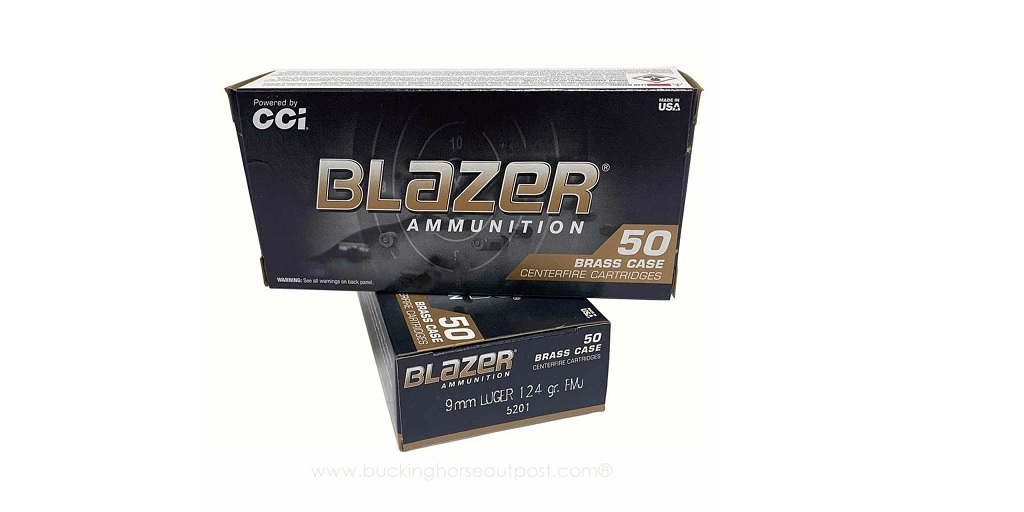
Thanks to a variety of factors, such as affordability, availability, suitable ballistic performance, and relatively light recoil, the 9mm Luger cartridge is one of the most popular handgun cartridges in the world.
It has been widely adopted by law enforcement officials and even for military applications and is equally widely carried by civilians for defensive use. The cartridge is also a great target-shooting cartridge because it offers a great combination of low recoil and affordability. Competitive shooters and hunters also have been known to carry and use 9mm handguns.
Because it is so widely used, the cartridge has been loaded with a very large range of different bullets. Two of the most common of these are 9mm full metal jacket bullets (also known as FMJ) and 9mm jacketed hollow-point bullets (also known as JHP).
But these should not be used interchangeably, or even for the same applications. Here’s a high-level view of what you need to know.
9mm Full Metal Jacket
High-quality 9mm full metal jacket bullets consist of a bullet with a lead core that is completely encapsulated by a metal jacket, which is generally made of a copper alloy.
Full metal jacket rounds are superior to a cheaper alternative, known as LRN, or lead-round nose bullets, for several reasons.
One, they are cleaner, and do not leave lead fouling (“leading”) deposits in your gun’s barrel. Leading is difficult to clean, and, more concerningly, is highly toxic.
Full metal jacket bullets are also more stable in flight and, since they are encapsulated in a harder jacket, are more stable on impact. This guarantees a higher level of accuracy as well as consistent penetration.
While full-metal jacket bullets are typically more expensive than bare lead bullets, they are more affordable than hollow points (see below) and since they are stable and accurate, are highly suitable for high-volume target shooting or competition.
9mm Hollow Point
Another type of common 9mm ammo is called hollow point, sometimes referred to as jacketed hollow point if the bullet is jacketed.
Hollow point ammunition has a depression in the nose of the bullet. Occasionally, there is a center post in the middle of the depression, or the jacket is skived (scored) such as in the case of Federal HST ammo.
This depression in the nose of the bullet causes the bullet to expand rapidly upon impact with a soft target. This controlled, consistent expansion results in a larger wound channel and makes the bullet much more efficient at dumping its kinetic energy.
Therefore, all else being equal, hollow-point bullets have greater stopping power and are more suitable for neutralizing a hostile target.
However, this does not paint the entire picture, as hollow point bullets are also designed not to overpenetrate. The fact that they dump their energy more efficiently also means they stop more rapidly when entering a soft target, minimizing the risk of continuing through and out of the target.
It is also the case that 9mm hollow point ammo tends to be more expensive than 9mm full metal jacket ammo, so it’s best reserved for defensive applications, whereas FMJ ammo is most suitable for competition, training, and target practice.
Shooting the Best 9mm Ammo for the Application
Considering cost and ballistic performance, it’s a good idea to use ammo where it is designed to perform. Save your FMJ bullets for the range and your JHP bullets for defensive applications.
