
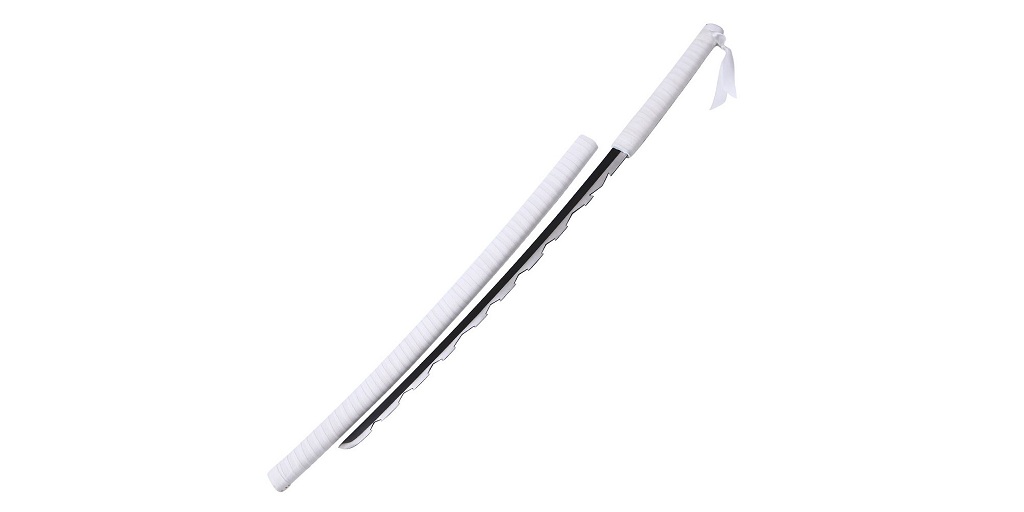
Inosuke Hashibira is one of the most popular characters in Demon Slayer: Kimetsu no Yaiba, whose fans love him for his perky outlook and upbeat demeanor. He makes hunting demons fun – almost a game – and uses quirky techniques and weapons.
Speaking of which, did you know these five facts about Demon Slayer Inosuke’s swords and other Nichirin weapons?
1. Inosuke Hashibira intentionally uses chipped blades.
Of course, you noticed that Inosuke carries two Nichirin katanas – but does anything stand out about them?
The blades are chipped!
This is no accident. Inosuke intentionally wields these chipped blades for a very specific reason.
He wants his demon prey to feel the pain of a thousand blades.
Inosuke tells Tanjiro that it makes the demon that was sliced “experience the feeling of being sliced by a thousand blades!”
Of course, the cool factor is no doubt a hit here, too.
2. Nichirin Swords are forged from special Iron Sands and Ores.
Nichirin swords, like Inosuke’s dual katanas, are made from special Iron Sands and Ores – specifically, Scarlet Crimson Iron Sands and Scarlet Ores, mined high in the mounds. Choice sands and ores come from the Sunlight Mountain, which is soaked in sunlight all year round.
3. Nichirin Swords have a unique power that gives them a special edge (no pun intended) over demons.
Because the Iron Sands and Ores that are used to produce Nichirin blades are bathed in sunlight year-round, this gives them special powers.
Because of this unique property, Nichirin blades are remarkably effective at dispatching demons, converting them into ash.
4. The skill of the bearer can change the color of the sword.
Bearers that have attained a certain level of skill can change the color of their blades when drawing them. For this reason, they are sometimes referred to as “Color Changing Katanas.”
Demon Slayer Inosuke’s swords are indigo-gray.
5. Demon Slayer Inosuke’s Swords do not have a “proper” hilt.
Classic katanas have a Tsuba, or guard. Not only do Inosuke’s blades lack a Tsuba, they are also without a proper hilt.
Instead, Inosuke has wrapped the tangs (Nakago, in Japanese) of his dual katanas with bandages that improve his grip.
Bonus fun fact: The same steels used to produce Nichirin swords are also used to produce bullets!
The steels that produce Nichirin blades are perfect for demon slaying because of their unique attributes.
Characters like Genya Shinazugawa took advantage of this in other creative, unique ways.
Shinaguzawa carries a double-barreled shotgun loaded with Nichirin bullets – the ideal ordnance for demons.
Don’t Settle for an Imitation Demon Slayer Inosuke Sword!
Alright, so maybe you know these interesting facts about Demon Slayer Inosuke’s swords.
But do you know where you can get a high-quality, real-life replica?
At Ice Imports – IceImports.com.
Their replica is a perfect likeness of Inosuke’s Demon Slayer sword. It’s 40 inches in length and made of high-quality, high-carbon steel, and it has a blunt edge, which makes it perfect for cosplay.
Check out the link above to learn more or get in touch with their customer service team at 860-439-0621.
